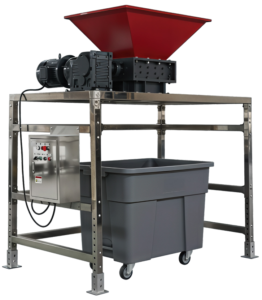


A bone grinder turns hard bones, hides, fruit stones, and fibrous plant waste into small, uniform pieces that compost, digest, or render far faster than whole material. Bierman Equipment supplies the Power Knot BCG-315, a double-shaft industrial bone grinder rated at 400 lb/h that farms, meat processors, and rendering operations nationwide use to stop hauling bone waste and start processing it on site.
What Is a Bone Grinder Used For?
A bone grinder shreds bones, hides, fruit stones, and fibrous organic waste into small pieces before disposal, composting, digestion, or rendering. Smaller pieces break down faster, cost less to haul, and stay out of equipment that cannot handle whole bone.
Common jobs for the BCG-315 include:
- Pre-breaking bones before they go into an LFC biodigester
- Shredding cow hides and animal byproducts for easier composting
- Breaking down avocado stones and other fruit stones
- Shredding fibrous material such as pineapple tops and lemongrass
- Preparing bone for bone meal and fertilizer production
- Reducing volume ahead of rendering, pet food, and feed manufacturing
The same machine goes by several names: pre-breaker, prebreaker, bone shredder, and animal meat rendering crusher. Whatever your team calls it, the job is size reduction before the next step in your waste stream. See the full range of waste processing equipment that works alongside it.
BCG-315 Industrial Bone Grinder Specifications
The BCG-315 is a reinforced-frame, double-shaft grinder built for continuous, heavy-duty operation. These figures come from the manufacturer specification sheet.
| Specification | BCG-315 |
|---|---|
| Capacity | 180 kg/h (400 lb/h) |
| Largest bone accepted | 400 mm (16 in) |
| Output particle size | 15 to 35 mm (0.6 to 1.3 in) |
| Motor | 5.5 kW, low-speed, high-torque, reversible to clear blockages |
| Shredding system | Double-shaft shredder for hard and fibrous materials |
| Gearbox | K-Series gearbox for reliability and long life |
| Cutting knives | Heat-treated for extended durability |
| Frame | Reinforced steel, can be disassembled for relocation; optional adjustable legs for height and floor anchoring |
| AC supply (order one type) | 208 V (187 to 230 V), 60 Hz, without neutral (3L+PE), or 400 V (360 to 440 V), 50 Hz |
| Controls | Wall-mounted control box with emergency stop |
| Warranty | One year |
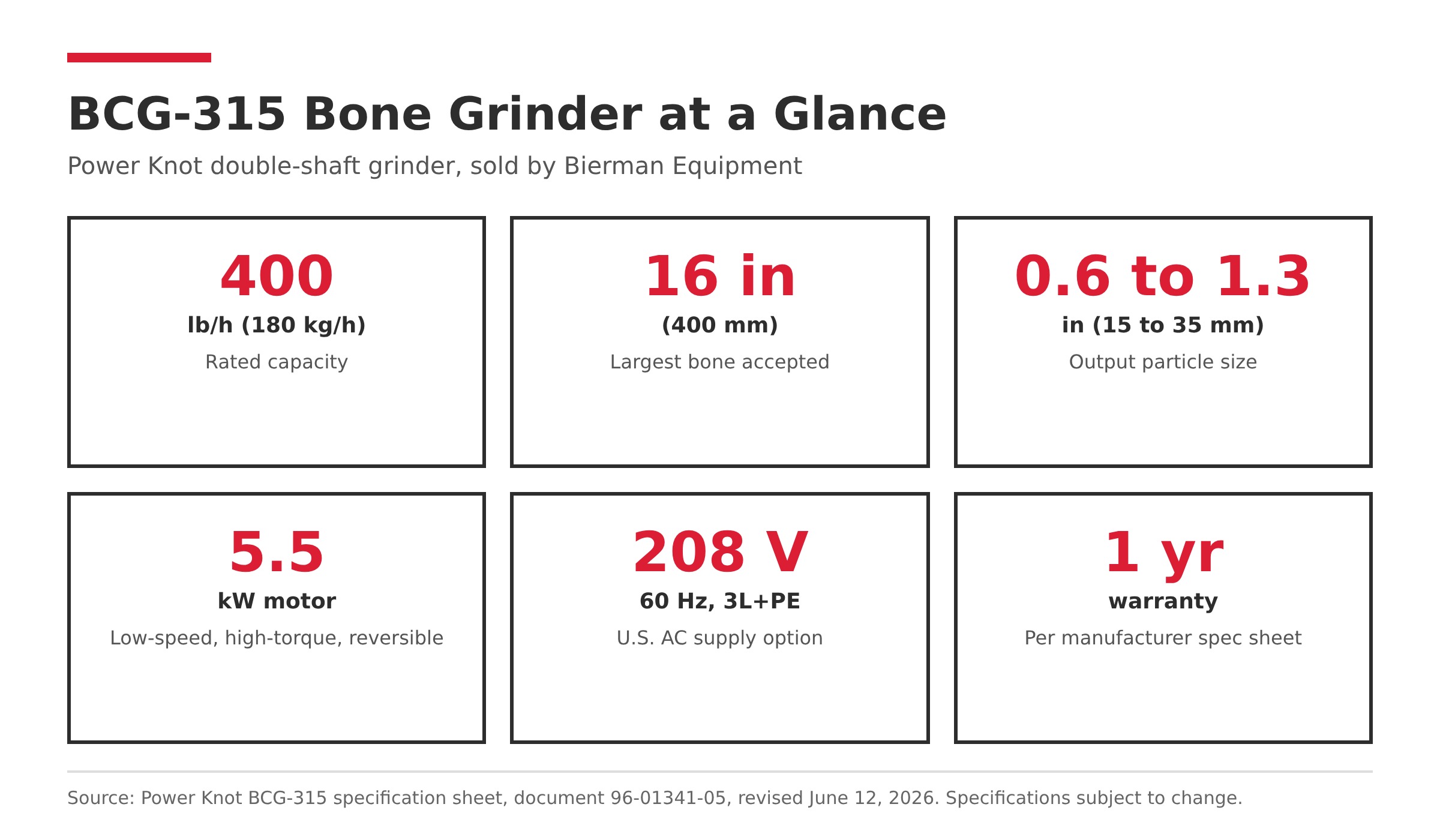
Source: Power Knot BCG-315 specification sheet, revised June 2026.
Download the BCG-315 Spec Sheet
How the BCG-315 Bone Grinder Works
Operators load material through the hopper, the double shafts shear it, and the ground output drops into a bin below. The process takes five steps:
- Load: Feed material through the custom hopper, which is designed for safe, ergonomic loading. The chute keeps hands away from the grinding mechanism.
- Shear: A low-speed, high-torque motor drives the double-shaft shredder through a K-Series gearbox, so heat-treated knives work through bone and fibrous material without high-speed noise.
- Clear: If material jams, reverse the motor to clear the blockage.
- Collect: Ground material falls into a bin at the bottom. Tip it into an LFC biodigester or load it into the bin for an LFC-1000.
- Clean: Rinse the cutting blades with a hose.
Operator Safety and Maintenance Features
- Key lock: prevents use by anyone who is not trained and authorized to run the machine
- Protective chute: blocks operator access to the grinding mechanism during loading
- Emergency stop: wall-mounted control box with a dedicated stop
- Hose-down cleaning: accessible surfaces and washable blades simplify sanitation
- Relocatable frame: disassembles for moving to a new location
What Materials Can a Commercial Bone Grinder Handle?
The BCG-315 handles hard, dense, and fibrous organic waste that would jam or damage lighter equipment. The table shows what to load and what it does for your downstream process.
| Material | BCG-315 | Result |
|---|---|---|
| Animal bones | Yes, up to 400 mm (16 in) | Reduced to 15 to 35 mm pieces for composting, digestion, or rendering |
| Cow hides | Yes | Grinding raises surface area so bacteria and fungi break hides down faster |
| Fruit stones, including avocado stones | Yes | Material you would not otherwise put in a biodigester |
| Fibrous plant waste (pineapple tops, lemongrass, plant stalks) | Yes | Shredded for easier handling and digestion |
| Raw vegetables | Optional | LFC biodigesters digest raw vegetables better after grinding |
| Construction rubble, brick, concrete | Not intended | Use a crusher built for aggregate (see the comparison below) |
Bone Grinder and Biodigester: Process What You Could Not Dispose Of Before
LFC aerobic biodigesters break down meat and poultry in about 24 hours, but they are not compatible with full bones or beef hides. A bone grinder closes that gap by sizing those materials so they can be handled in small quantities.
| Waste stream | Without a grinder | With the BCG-315 |
|---|---|---|
| Full bones | Not compatible with LFC biodigesters | Ground first; small quantities (typically up to 10% of nominal daily capacity) can go in |
| Beef hides | Not compatible with LFC biodigesters | Ground for composting with far more surface area |
| Raw vegetables | Digested, but less efficiently | Digested better after grinding |
| Fruit stones and fibrous plant waste | Normally kept out | Ground and accepted |
Handling is simple. The grinder deposits output into a bin that tips into an LFC unit or loads into the bin tipper on an LFC-1000, which lifts up to 70 kg (155 lb) per cycle and accepts ANSI and EN bins.
How Bone Grinding Speeds Composting and Digestion
Grinding increases the surface area microbes can reach, which shortens the time bone and hide take to break down. The USDA Livestock Mortality Composting Protocol describes static windrow composting as a process that takes 6 to 12 weeks. Research hosted by the National Pork Board found that particle reduction could cut the lost production time to 14 to 21 days, and ground carcasses showed only small bone fragments after 7 days.
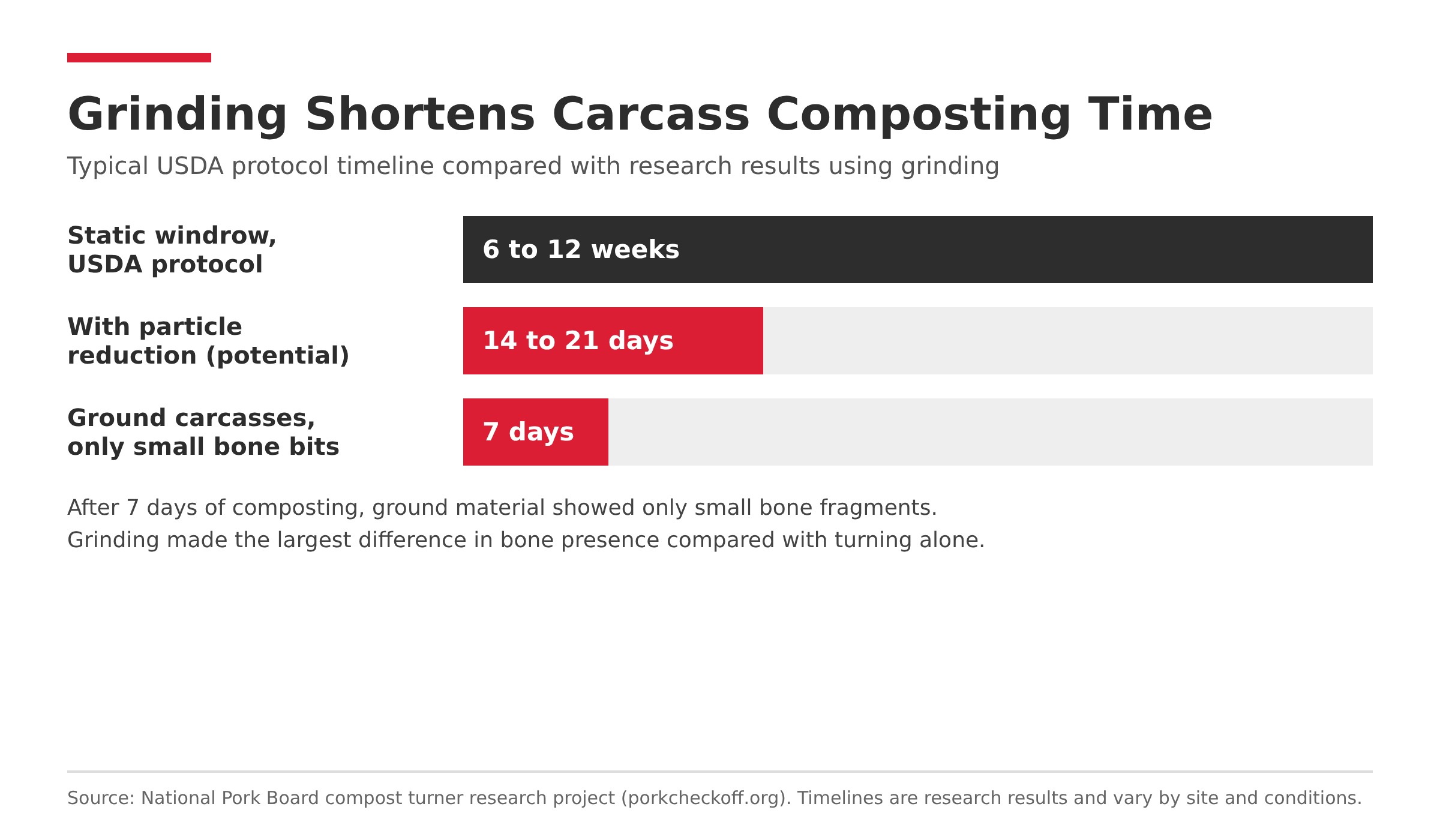
Source: National Pork Board compost turner research project.
That study used large horizontal grinders on whole sow carcasses, so treat it as evidence for the principle rather than a performance claim for the BCG-315. The takeaway holds for any operation: smaller, more uniform material breaks down faster.
Particle Size Targets for Composting
University of Wisconsin-Madison Extension recommends a particle size of 0.25 to 1 inch for mortality composting. Rapid-composting guidance from the University of Arkansas Division of Agriculture lists 1/8 to 1/2 inch. The BCG-315 output of 0.6 to 1.3 inches overlaps the upper part of the Wisconsin range and runs coarser than the Arkansas range.
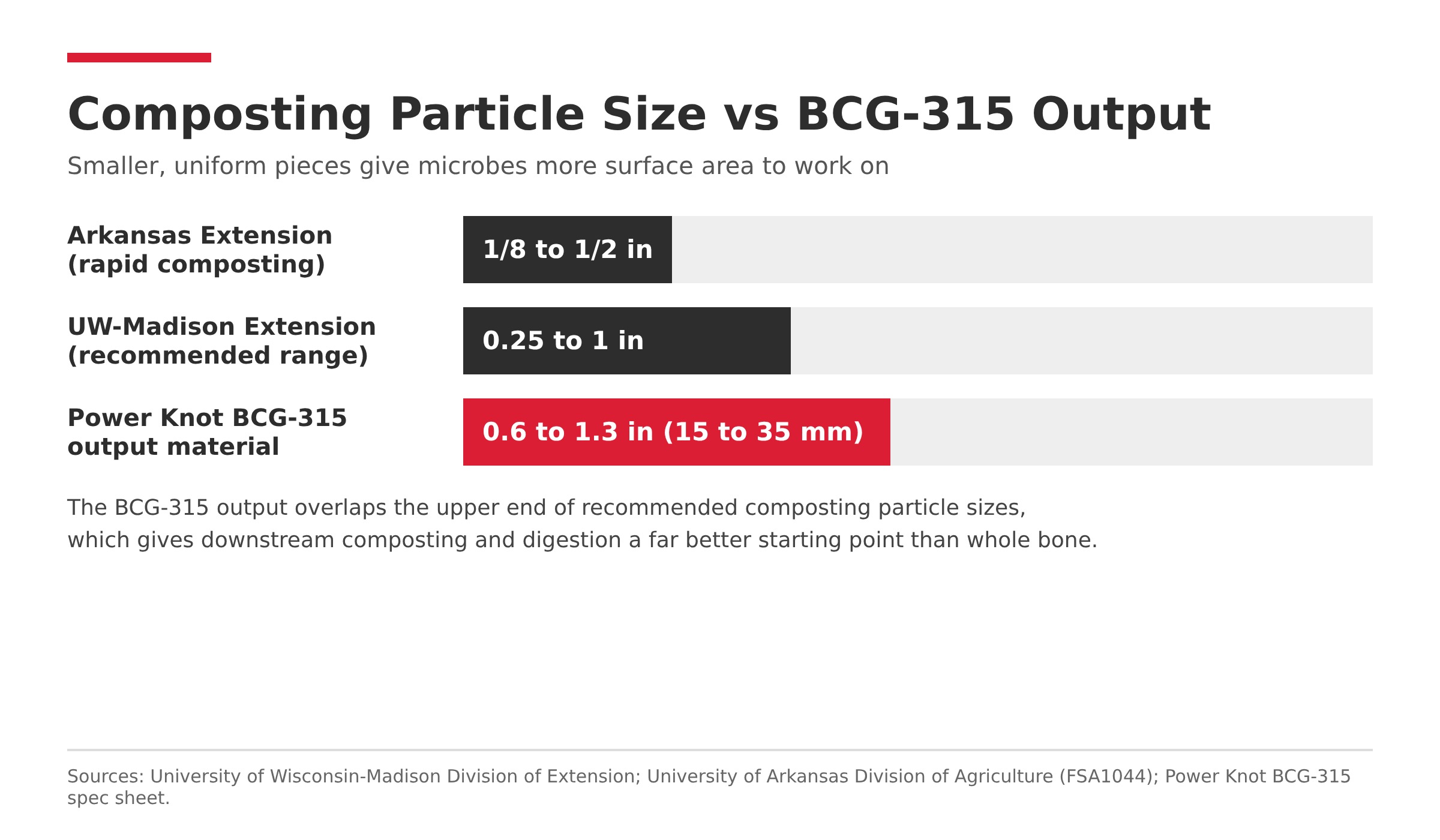
Source: University of Wisconsin-Madison Division of Extension.
In practice, the grinder is the first size-reduction step. Pair it with a composter or digester that finishes the job. BIOvator composters suit operations that prefer composting.
Operations that want an enclosed, controlled composting process can also look at in-vessel composters.
Bone Grinder Applications by Industry
The manufacturer lists nine applications for the BCG-315. Each one uses the grinder as a size-reduction step ahead of another process.
| Application | What the grinder does |
|---|---|
| Agriculture waste management | Reduces bone, hide, and plant waste before composting or digestion |
| Bone meal and fertilizer production | Creates uniform particles for downstream processing |
| Food waste recycling and processing | Breaks down hard and fibrous components so digesters and composters work more efficiently |
| Meat, poultry, and seafood rendering | Pre-breaks bone before rendering |
| Pet food and animal feed manufacturing | Sizes bone and dense material for further processing |
| Livestock and slaughterhouse operations | Processes bone and hide on site instead of hauling it away |
| Pharmaceutical material processing | Reduces dense organic material to uniform pieces |
| Renewable energy and biofuel | Prepares dense organic feedstock for digestion |
| Wildlife and zoo feed preparation | Sizes bone and dense material for feed |
Meat processors and poultry or livestock operations that want to dehydrate mortality as well can review the BioRoter dehydrator.
Benefits of Grinding Bone Waste On Site
On-site grinding lowers handling costs and risk because less raw waste leaves your property. The manufacturer highlights these benefits:
- Uniform particles: consistent output makes every downstream step easier
- Lower volume and cost: less waste to transport and dispose of
- Reusable byproducts: bone and plant waste become material you can recycle
- Better hygiene: less decomposition and odor buildup before disposal
- Fewer pests: reduced contamination risk from stored organic waste
- Continuous duty: built for heavy-duty, ongoing operation
- Easy upkeep: accessible surfaces and washable blades
- Fewer off-farm pickups: less reliance on dead stock haulers, which limits outside vehicle traffic on your property
Bone Grinder vs Bone Crusher: Which Do You Need?
Choose a bone grinder to prepare organic waste for breakdown. Choose a crusher when you want hard rubble and bone turned into aggregate. The two machines solve different problems.
| Feature | Bone Grinder (BCG-315) | Bone and Aggregate Crusher |
|---|---|---|
| Main job | Shreds bone, hides, fruit stones, and fibrous waste | Crushes bone, rubble, and debris into aggregate |
| Typical output | 15 to 35 mm (0.6 to 1.3 in) | About 1.5 to 3 in |
| Materials | Organic: bone, hide, stones, plant fiber | Brick, light concrete blocks, pavers, asphalt, bone |
| End use | Composting, biodigester feed, rendering, bone meal | Foundations, yard surfacing, landscaping, roadways, base layers |
| Manufacturer | Power Knot | Solesbee's |
If your goal is usable fill or road base, the bone and aggregate crusher is the better fit. If your waste stream includes both organic material and rubble, you may need both machines.
How to Choose the Best Bone Grinder for Your Operation
Match the machine to your material, daily volume, power supply, and next processing step. Use this checklist before you request a quote.
| Question | BCG-315 reference |
|---|---|
| What is the largest piece you will load? | Bones up to 400 mm (16 in) |
| How many pounds per hour do you process? | Rated at 400 lb/h (180 kg/h) |
| What voltage do you have? | 208 V, 60 Hz, 3L+PE (or 400 V, 50 Hz) |
| What particle size does the next step need? | 15 to 35 mm (0.6 to 1.3 in) |
| Where does the output go? | Bin that tips into a biodigester or composter |
Match Capacity to Daily Volume
At the rated 400 lb/h, one 8-hour shift can process up to about 3,200 lb under ideal conditions. Real throughput depends on bone density, hide content, and loading rhythm, so size the grinder to your peak days rather than your average.
Check Power and Facility Requirements
Confirm your available voltage, floor space, and whether you want the optional adjustable legs and floor anchoring. The spec sheet lists grinder and stand dimensions, and our equipment team can walk through your layout and electrical setup with you.
Plan the Downstream Step
A grinder shortens breakdown time but does not remove the need for a finishing process. Decide whether ground material goes to a biodigester, a composter, or rendering. Whole carcass disposal may call for agricultural incinerators alongside the grinder.
Bone Grinder for Sale: Request a BCG-315 Quote
Bierman Equipment supplies the BCG-315 nationwide and tests the equipment it sells on its own farm before recommending it. Tell us your daily volume, largest bone size, and available voltage, and we will help you size the right system.
Bone Grinder FAQs
What size bone can the BCG-315 bone grinder handle?
The BCG-315 accepts bones up to 400 mm (16 in) long. It is rated at 180 kg/h (400 lb/h) and reduces material to 15 to 35 mm (0.6 to 1.3 in) pieces. Very large bones may need to be cut down before loading.
Can a bone grinder process whole animal bones and cow hides?
Yes. The double-shaft shredder and heat-treated knives are built for hard bone and fibrous material, and the grinder is well suited to cow hides. Grinding increases surface area, so bacteria and fungi break hides and bone down more efficiently during composting.
Can I put ground bones in an LFC biodigester?
Small quantities, yes. LFC biodigesters are not compatible with full bones or beef hides, but ground bone can be added in small amounts, typically up to 10% of the digester's nominal daily capacity. The grinder's output bin tips directly into the digester.
What power supply does the BCG-315 require?
The BCG-315 uses a 5.5 kW motor. You order one AC supply type: 208 V (187 to 230 V) at 60 Hz without neutral (3L+PE), or 400 V (360 to 440 V) at 50 Hz. The 208 V, 60 Hz option matches standard U.S. three-phase supply.
How much does an industrial bone grinder cost?
Pricing depends on the power supply, stand, adjustable legs, shipping destination, and any options you add. Bierman Equipment quotes each system individually. Send your daily volume, largest bone size, and available voltage through the contact form to get an accurate quote.
What is the difference between a bone grinder and a bone crusher?
A bone grinder shreds organic material such as bone, hides, and fibrous waste into small pieces for composting, digestion, or rendering. A bone and aggregate crusher breaks bone and construction rubble into 1.5 to 3 inch aggregate for roadways, yards, and base layers.
Does grinding bones speed up composting?
Yes. Smaller particles give microbes more surface area to work on. Research hosted by the National Pork Board found that particle reduction with grinders left only small bone fragments after 7 days and could shorten the production time lost to composting from 6 to 12 weeks to 14 to 21 days.
How do you clear a jam in a bone grinder?
Reverse the BCG-315 motor to clear a blockage. The low-speed, high-torque drive can run in reverse, so operators can free jammed material without disassembling the machine. Always follow the manufacturer's lockout and safety procedures before reaching near the cutting zone.
Is the BCG-315 safe for operators to use?
The BCG-315 includes an operator chute that blocks access to the grinding mechanism, a key lock that restricts use to trained and authorized personnel, and a wall-mounted control box with an emergency stop. Blades can be cleaned with a hose.
What warranty comes with the BCG-315 bone grinder?
The manufacturer provides a one-year warranty on the BCG-315. Specifications are subject to change, so confirm current terms and the latest spec sheet when you request a quote.