


|
Hand-adding vitamins, trace minerals, and additives is slow, repetitive work, and every scoop is a chance for an error that follows the batch all the way to the feed bunk. Micro ingredient systems replace that manual step with controlled, weighed dispensing from dedicated bins, so each batch gets the same ingredient profile no matter who is working the shift. Built for feed mill owners, plant managers, and operations directors, this automated system pairs stainless steel micro bins, high-accuracy load cells, and drive controls rugged enough for daily agricultural production. The result is tighter formulation, less labor tied up in pre-mixing, and a consistent process your team can document. |

|
Why Hand-Adding Costs Feed Mills Money
Manual pre-mixing looks inexpensive because the equipment is a scale and a scoop. The real cost shows up in labor hours, wasted ingredients, and batches that miss specification. A scale misread, a scoop pulled from the wrong bin, or a rushed pre-mix during a high-volume shift can push a batch out of range in ways that stay invisible until an animal performance problem or an inspection brings them to light.
Small Errors Add Up Across a Batch
Micro ingredients are included at low rates, so a small weighing mistake becomes a large percentage error. As an illustration, if a recipe calls for 2 pounds of a trace mineral premix and the scoop runs half a pound heavy, that ingredient is 25 percent over target. Multiply that across dozens of batches per week, and the cost of over-dispensed vitamins, misidentified additives, and discarded batches becomes real money.
| Task | Manual Hand-Adding | Automated Micro Ingredient System |
|---|---|---|
| Weighing | Operator reads a scale and measures by scoop | High-accuracy S type load cells weigh each dispense |
| Ingredient selection | Operator chooses the right bag or bin under time pressure | Each ingredient has its own dedicated micro bin |
| Refilling | Bags are lifted and carried to the point of use | All micro bins can be filled from ground level |
| Labor | Skilled worker time tied up weighing and pre-mixing | Dispensing runs from the controls |
| Records | Handwritten logs that are easy to misplace or misread | Repeatable weights that can feed batching and inventory records |
| Equipment cleanup | Scoops, buckets, and open bags | Stainless steel bins and easily removable augers |
Moving skilled people away from weighing and pre-mixing is one of the most immediate gains an automated system delivers. That time returns to tasks that need human judgment, such as quality checks, scheduling, and equipment upkeep. It is a practical upgrade for any mill moving from manual steps to automation, and it fits alongside the full range of feed mill equipment available for batching, storage, and handling.
Micro Ingredient Systems Built for Daily Feed Production
A micro ingredient system stores small-inclusion ingredients in individual bins, meters each one out with an auger, weighs the result, and delivers it to the mixer through a trough. Every part of that path is built for repeated daily use, from the stainless steel bins to the gearmotors that turn the augers.
Micro Ingredient Systems with Stainless Steel Bins and Poly Augers
Stainless steel micro bins are built for a lifetime of use, and they resist the corrosion that vitamins, minerals, and moist additives can cause in painted or mild steel containers. Poly augers inside the bins reduce buildup, which matters for ingredients that tend to cling, cake, or bridge. Stainless lids with hooks hang on the hopper during refills, so the lid stays clean and out of the way instead of ending up on the floor.
- Multiple bin sizes and configurations: match bin capacity to how fast each ingredient is used.
- Custom builds: systems can be built to your specifications and floor plan.
- Ground-level filling: every micro bin can be filled without climbing or lifting overhead.
- Stainless brackets throughout: hardware stays as corrosion-resistant as the bins.
Accurate Weighing with NTEP-Approved Load Cells
Accuracy starts at the scale. The weigh hopper uses high-accuracy S type load cells, and the load cells are NTEP approved, which means the weighing components have been evaluated under the National Type Evaluation Program used for commercial weighing devices. The result is a dispensing record built on measured weight, not on a scoop count or an operator's estimate.
Gearmotors, Variable Frequency Drive Control, and the Trough
Each micro bin runs on a one-half horsepower, three-phase motor with a 20:1 gearbox, and a variable frequency drive controls the system so dosing speed can be matched to the ingredient. The weigh hopper uses a 1 horsepower motor with a 10:1 gearbox. Ingredients move to the mixer through a commercial grade 6 inch U trough built from 12 gauge steel with a poly liner, or from all stainless steel, with a 6 inch poly U trough auger that reduces buildup.
| Component | Specification |
|---|---|
| Weighing | High-accuracy S type load cells, NTEP approved |
| Micro bins | Stainless steel, multiple sizes and configurations, custom builds available |
| Bin lids | Stainless steel with hooks that hang on the hopper for easier refilling |
| Bin augers | Poly augers that reduce buildup, easily removable for maintenance |
| Bin drive | 1/2 HP three-phase motor with 20:1 gearbox on every micro bin |
| Controls | Variable frequency drive |
| Trough | Commercial grade 6 in. U trough, 12 ga. steel with poly liner or all stainless steel |
| Trough auger | 6 in. poly U trough auger that reduces buildup |
| Weigh hopper drive | 1 HP motor with 10:1 gearbox |
| Frame | Heavy-duty support frame, primed and painted |
| Options | Platform and stairs; weigh hopper extension past the support frame for a tote bag system |
Dosing Vitamins, Minerals, and Additives Accurately
Vitamins, trace minerals, and feed additives share a common challenge. They are high in value, concentrated, and often awkward to handle by hand. Some pick up moisture and bridge. Others are included at such low rates that a small dispensing error changes the nutritional profile of the whole batch.
Vitamins and Trace Minerals
Dedicated bins keep each vitamin or mineral premix separate, and weighed dispensing replaces the small daily errors that build up when people measure by hand. Over a full production week, steady dosing means every load of feed leaves the mill closer to the formulation you designed.
Medicated Feed Additives and Veterinary Feed Directive Feeds
Feeds that carry medicated additives or Veterinary Feed Directive drugs come with extra handling and recordkeeping duties. Automated dosing helps by giving operators a repeatable, weighed process for the additive step, which is easier to document and audit than a series of manual scoops. Stainless steel contact surfaces and easily removable augers also make cleanout between ingredients more practical.
Sticky and Low-Inclusion Ingredients
Poly augers in both the micro bins and the trough reduce buildup, and multiple bin sizes let you give a slow-moving ingredient a small bin and a high-use ingredient a larger one. If you handle an unusually sticky or fine ingredient, share it with our team when you plan the system so the bin and auger setup can be matched to it.
Ready to see what automated dosing looks like in your mill? Our team can prepare a custom system concept and budget proposal around your ingredients and layout.
Batch Records and FSMA Preventive Controls Documentation
Feed mills operate under the FDA rules for animal food, and documentation sits at the center of them. Automated dispensing does not replace your food safety plan, but it gives that plan a more reliable process to document.
What Part 507 Expects from a Feed Facility
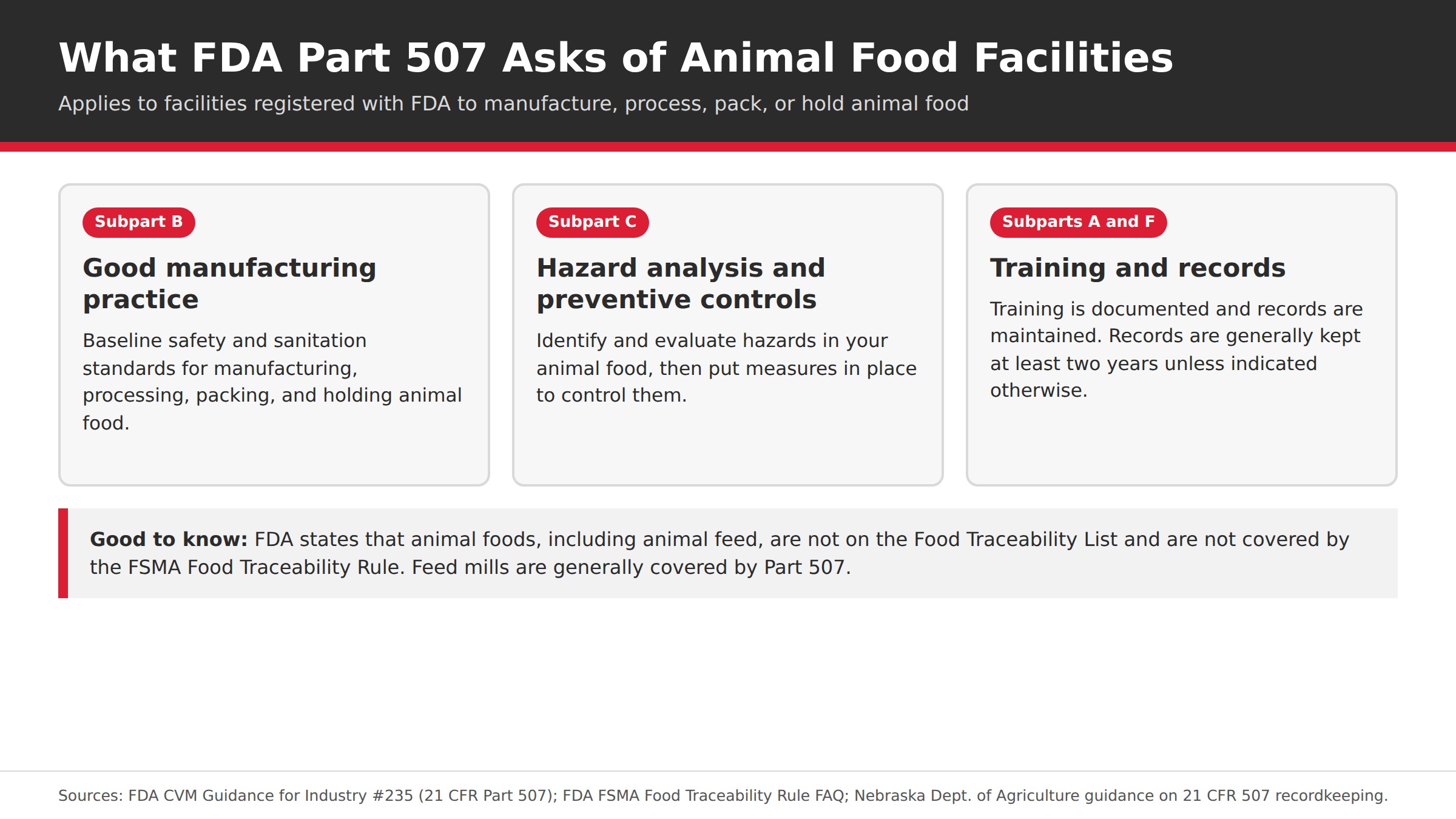
The FSMA animal food rule, codified in 21 CFR Part 507, combines good manufacturing practice, written hazard analysis and preventive controls, training, and recordkeeping for facilities that manufacture, process, pack, or hold animal food. Records are generally kept at least two years unless the rule indicates otherwise. A repeatable weighing process makes it easier to show that your preventive controls for ingredient additions run the same way every batch.
How Automated Dispensing Supports Your Records
Weighed, repeatable dosing produces consistent inputs that are simple to record at the batch level. Pair the system with batching, reporting, and inventory software and ingredient usage can be tracked against what the recipe called for, which supports reconciliation and gives your team a clear picture of where each ingredient went.
Reducing Cross-Contamination and Cleanout Time
Carryover between ingredients, and between medicated and non-medicated runs, is a risk category that equipment design can help control. Procedures matter, but equipment that is easy to clean makes procedures easier to follow.
- Easily removable augers: pull them for inspection and cleaning without tearing down the system.
- Stainless steel bins and brackets: durable contact surfaces that stand up to repeated cleaning.
- Poly liner or stainless trough: choose the trough construction that fits your ingredient mix and sanitation routine.
- Dedicated bins: each ingredient stays in its own bin, so ingredients are not shared through scoops and buckets.
Planning and Sizing a Micro Ingredient Batching System

|
Every mill is laid out differently, so these systems are built around your space and ingredient list. Multiple bin sizes and configurations are available, and the system can be custom built to your specifications. A heavy-duty support frame, primed and painted, carries the bins and hopper.
|
Bin Count and Ingredient Planning
Start with a list of every micro ingredient you add, along with its typical inclusion rate and how often you use it. High-use ingredients may justify larger bins, while specialty additives can sit in smaller ones. That list tells our team how many bins you need and how they should be arranged.
Fitting the System into Your Mill
Measure the available floor space and the clearance above the mixer, and note where power will come from, since the motors are three-phase. If bulk ingredients arrive by truck and move through grain handling equipment before they reach the mixer, a plan that shows both flows keeps the layout clean. For bulk storage upstream of the mixer, poly bins for bulk feed storage can complement the micro system.
Getting a Concept and Budget Proposal
When you are ready, send your ingredient list and mill dimensions so our team can prepare a system concept and budget proposal. Bierman Equipment tests equipment on its own farm before recommending it and works with feed mills nationwide.
Request a Micro Ingredient System Proposal
Get a Custom System Concept and BudgetTell us about your ingredients, batch sizes, and available space, and our team will follow up with a system concept and budget proposal.
|
Frequently Asked Questions About Micro Ingredient Systems
What is a micro ingredient system?
A micro ingredient system is an automated set of bins, augers, and a weigh hopper that dispenses small-inclusion feed ingredients such as vitamins, trace minerals, and additives. It replaces manual hand-adding with weighed, controlled dosing.
How does the system weigh ingredients accurately?
The weigh hopper uses high-accuracy S type load cells that are NTEP approved. Each ingredient is dispensed from its own micro bin and weighed, so dosing is based on measured weight instead of a scoop count.
Does the FSMA Food Traceability Rule apply to feed mills?
FDA states that foods for animals, such as animal feed, are not on the Food Traceability List and are not covered by the Food Traceability Rule. Feed mills are generally covered by the FSMA animal food rule in 21 CFR Part 507, which includes preventive controls and recordkeeping requirements.
Can the system handle sticky or low-inclusion ingredients?
Poly augers in the micro bins and in the trough reduce buildup, and multiple bin sizes let you match bin capacity to each ingredient. For an unusually sticky or fine ingredient, share it with our team during planning so the setup can be matched to it.
Can we customize the number of bins and the layout?
Yes. Multiple bin sizes and configurations are available, and systems can be custom built to your specifications. Options include a platform with stairs and a weigh hopper that extends past the support frame to accommodate a tote bag system.
What motors and controls does the system use?
Every micro bin runs on a 1/2 HP three-phase motor with a 20:1 gearbox, the weigh hopper uses a 1 HP motor with a 10:1 gearbox, and a variable frequency drive controls the system.
How do I get a quote for a micro ingredient system?
Send your ingredient list, batch sizes, and mill dimensions through the quote request form or the contact form. Our team will follow up with a system concept and budget proposal.