

At Bierman Equipment, we help farms, feed mills, and livestock operations build systems around feed mill and livestock equipment that actually works together in daily production. From receiving grain and storing ingredients to batching, conveying, and managing livestock through breeding, housing, and daily handling, every stage depends on equipment that is sized correctly and connected to the rest of the operation. We work with producers who want practical, durable solutions rather than a list of disconnected machines.
A modern agricultural operation rarely runs on one piece of equipment alone. Feed production depends on how ingredients are received, stored, weighed, and moved. Livestock management depends on how animals are housed, gated, sorted, and cared for every single day. When these systems are planned together, the result is a facility that is easier to run, safer for employees, and better positioned for growth. That is the approach we bring to every conversation with a farm, mill, or integrator.
Feed Mill and Livestock Equipment for Every Stage of Production
Good feed mill and livestock equipment supports the full cycle of production rather than a single task. On the feed side, that means grain intake, storage, batching, mixing, and discharge working in sequence without unnecessary manual steps. On the livestock side, it means housing, feeding, gating, and monitoring systems that keep animals calm, workers safe, and daily routines predictable. Whether an operation raises swine, poultry, or mixed livestock, the underlying goal stays the same: fewer bottlenecks, more consistency, and equipment that holds up to years of daily use.
Ingredient flow is just as important as ingredient capacity. A large storage tank does not solve a production problem if discharge rates are inconsistent or if material cannot be metered accurately during batching. In the same way, a spacious barn does not automatically improve labor efficiency if gating and access points are not designed around how workers actually move animals. Equipment selection has to start with how the facility runs today, not just how it looks on a layout drawing.
- How much feed needs to be produced on a daily or weekly basis
- What ingredients are handled and in what volumes
- Whether batching needs are simple or require automation and reporting
- How animals move between breeding, gestation, farrowing, or grow-finish areas
- How material, feed, and livestock are received, stored, and discharged
- How much room exists for current production and future expansion
Grain Handling, Storage, and Ingredient Control
Grain handling and storage form the foundation of any feed production system. If ingredients cannot be stored properly or moved reliably, every downstream step becomes harder to manage. We help producers compare storage tanks, conveying equipment, and flow control components that keep ingredients organized and ready for batching, without creating unnecessary manual handling along the way.
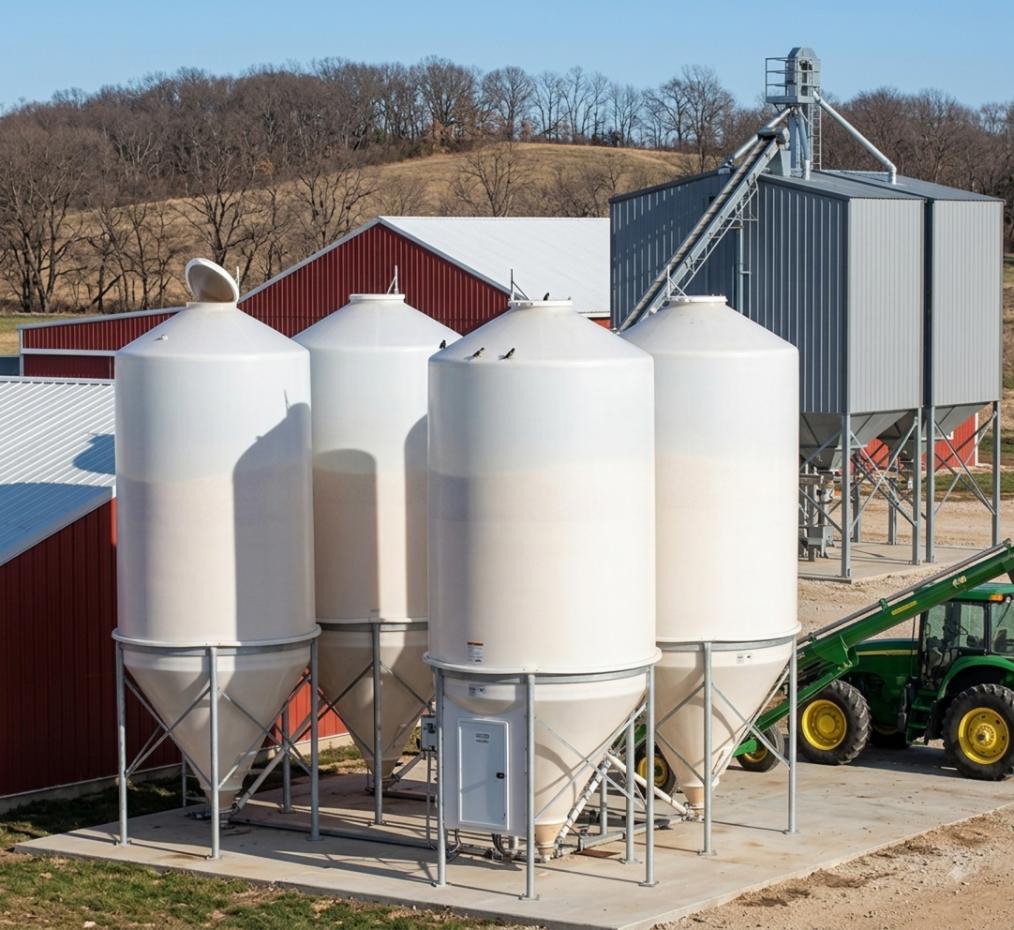
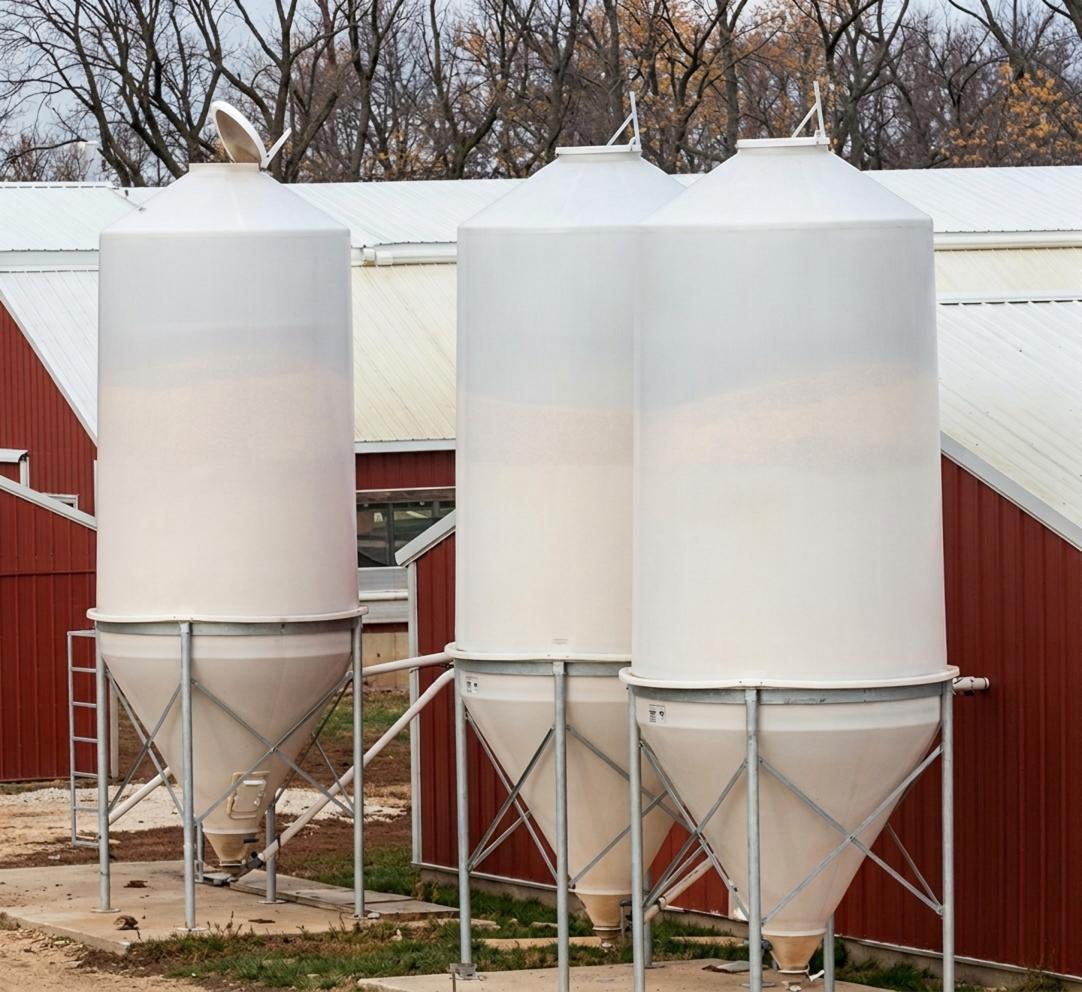
Poly Feed Bins and Bulk Storage Tanks
Reliable storage protects ingredients from moisture and contamination while keeping inventory organized and easy to access during batching. Our poly feed bins and bulk storage tanks are built to hold up under constant use while helping producers keep ingredients fresh and readily available, which supports both feed quality and daily efficiency at the mill.
Grain Conveying with Schlagel Equipment
Once ingredients are stored, they need to move through the facility without excessive handling or downtime. Schlagel grain conveying equipment has supported grain-handling operations for decades, and it fits naturally into a system that needs dependable transfer between storage, batching, and discharge points. Smooth conveying reduces spillage, lowers labor demands, and keeps material moving at a predictable pace.
| Production Stage | Common Equipment Category | Primary Benefit |
|---|---|---|
| Receiving and Storage | Poly feed bins, bulk tanks, grain conveyors | Protects ingredients and keeps inventory organized |
| Batching and Mixing | Feed mill software, micro-ingredient systems | Improves batching accuracy and reporting |
| Livestock Housing | Sow housing systems, gating and fencing | Supports animal movement and labor efficiency |
| Sorting and Handling | Automated sorting systems, bin tippers, attachments | Reduces manual labor and improves throughput |
Batching Accuracy and Feed Mill Automation
Batching is where formula accuracy either holds up or falls apart. Producers running multiple feed formulas need equipment that can weigh, track, and report on every batch without relying on manual logs. Automation does not have to mean a complete facility overhaul. In many cases, adding the right batching or reporting tool to an existing mill makes the biggest difference in day-to-day accuracy.
Our feed mill batching and reporting software gives operations a network-based system for managing recipes, ingredients, and production records from anywhere on the facility network. Faster batching and clearer reporting reduce errors and give managers a better picture of what is actually happening at the mill each day, rather than relying on paper logs after the fact.
Micro-Ingredient Batching for Precision and Safety
Vitamins, minerals, and other micro-ingredients require a different level of precision than bulk grain handling. A micro-ingredient batching system loads from floor level and measures small quantities far more accurately than hand-adding or pre-mixing methods. Beyond accuracy, it reduces the physical strain on employees who would otherwise be lifting and measuring these ingredients manually multiple times per shift.
Livestock Housing, Movement, and Facility Systems
Feed production is only part of an efficient livestock operation. How animals are housed, fed, moved, and monitored inside the facility has just as much impact on labor demands, safety, and overall performance. We help producers compare housing, gating, sorting, and partition systems that improve animal handling while making daily management more predictable for staff.
Sow Housing and Group Management Equipment
Sow facilities need to support reproductive management, safe animal movement, and routine feeding without creating unnecessary labor strain. Our sow housing equipment covers everything from drop and trickle feed stations to automated gestation systems, giving producers options that fit both new construction and retrofit projects.
Hog Gating and Fencing for Safer Animal Movement
Gating is used constantly throughout the day, which makes it one of the most important components in any livestock facility. Custom-built hog gating and fencing systems support safe movement between breeding, gestation, and finishing areas while standing up to years of animal contact, cleaning, and daily wear.
Automated Sorting with SortAll Revolution 2
Manually weighing and sorting groups of pigs takes time and pulls staff away from other tasks. The SortAll Revolution 2 automated sorting system uses stainless steel scales with a browser-based interface to track and sort animals automatically, giving producers accurate data on herd progress without adding extra labor hours.
Paneltim Panel Systems for Barns and Partitions
Barns and group housing areas need materials that hold up to constant cleaning and moisture without breaking down over time. Paneltim panel systems are lightweight, strong, and easy to sanitize, which makes them a practical fit for partitioning, flooring, and building components across a range of livestock species and barn layouts.
Material Handling and Facility Support Equipment
Beyond feed batching and livestock housing, most operations also need equipment that supports the physical movement of materials around the facility. These categories often get overlooked during planning, but they can create some of the biggest labor savings when chosen correctly.
Bin Tipper Equipment for Efficient Unloading
Manually dumping totes, carts, or bins is slow and puts unnecessary strain on employees. Bin tipper equipment mechanically lifts and inverts containers for faster, safer unloading, which is useful anywhere material needs to move from a cart or tote into a hopper, mixer, or storage bin.
Equipment Attachments for Everyday Facility Tasks
Day-to-day facility work often depends on attachments that make existing equipment more versatile. Our agricultural equipment attachments help producers handle a wider range of tasks around feed mills and livestock facilities without purchasing an entirely separate machine for every job.
How to Choose the Right Feed Mill and Livestock Equipment for Your Operation
Choosing equipment starts with understanding how the entire operation functions, not just which machine looks the most capable on a spec sheet. We encourage producers to think about how feed production, storage, handling, and livestock systems connect to one another. The equipment that helps the most is the one that improves the broader workflow, not just one isolated task.
- Daily and weekly production targets
- Current facility layout and any structural constraints
- Labor availability and safety priorities
- Ingredient types, volumes, and storage requirements
- Animal housing, movement, and sorting needs
- Maintenance expectations and long-term durability
- Expansion plans and future production goals
Questions to Ask When Comparing Feed Mill and Livestock Equipment
A useful way to compare feed mill and livestock equipment is to ask where the current operation loses the most time. Is batching slower than it should be because of manual weighing? Is labor tied up moving animals through poorly designed gating? Is ingredient storage creating spoilage or inconsistent discharge? Answering those questions first makes it much easier to prioritize which category to address, whether that means starting with storage and conveying, batching automation, or livestock housing and handling systems.
Grain handling safety and design guidance from sources such as Iowa State University’s feed mill and grain science research can also be a useful reference point when planning storage, batching, or handling upgrades, particularly for operations weighing new construction against retrofitting an existing facility.
Talk with Bierman Equipment About Your Feed Mill and Livestock Equipment Needs
We help farms, mills, and livestock operations across the country compare solutions for feed production, material handling, storage, and facility performance. You can see everything Bierman Equipment provides for agricultural operations nationwide, and our team is ready to talk through your production goals, facility layout, and labor needs to help identify the right equipment for your operation.
Frequently Asked Questions
What is included in feed mill and livestock equipment?
It covers the systems used to receive, store, batch, mix, and move feed ingredients, along with the housing, gating, sorting, and material handling equipment used to manage livestock through daily production.
How do we know which equipment category to start with?
We usually start by identifying where the current operation loses the most time or labor, whether that is inconsistent batching, slow ingredient storage and discharge, or gating and movement issues in the barn.
Can new feed mill equipment integrate with existing grain bins and conveyors?
In many cases, yes. Storage, conveying, and batching components can often be added or upgraded in stages rather than replacing an entire system at once, depending on the existing layout and equipment condition.
What is the difference between feed mill software and a micro-ingredient batching system?
Feed mill software manages recipes, batching, and reporting across the whole operation, while a micro-ingredient batching system is focused specifically on accurately measuring small-volume ingredients like vitamins and minerals.
How does gating and fencing affect labor efficiency in a livestock facility?
Gating is used constantly throughout the day, so a well-designed layout reduces bottlenecks, supports safer animal movement, and makes routine tasks like sorting and transfer faster for staff.
Can feed mill and livestock equipment be added in phases?
Yes. Many operations improve their systems over time based on budget, production priorities, and which categories are creating the most immediate bottlenecks.
Does Bierman Equipment work with operations outside Iowa?
Yes. While our team is based in Larrabee, Iowa, we work with farms, mills, and livestock operations across the country to plan and supply feed mill and livestock equipment.