


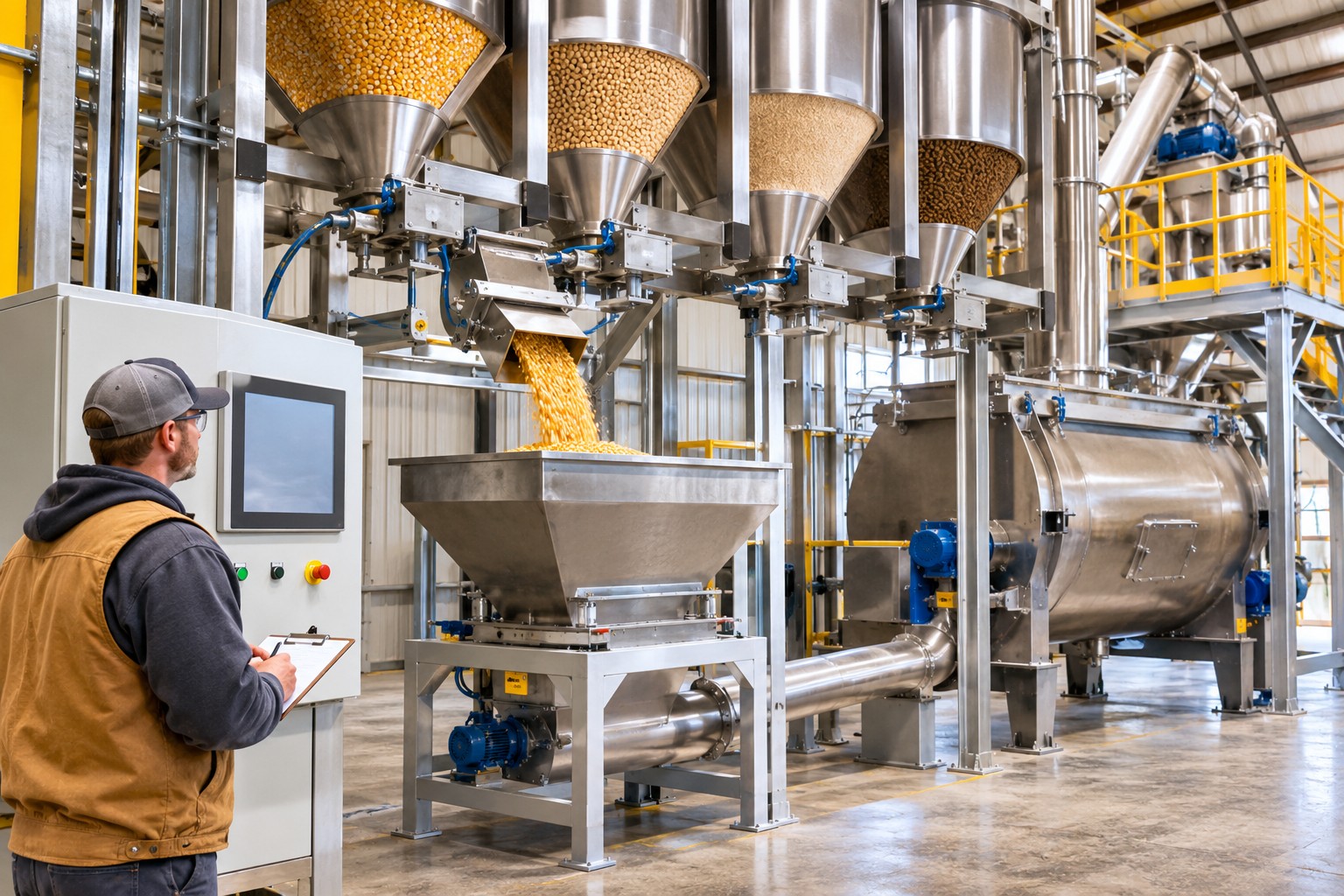
Feed mill automation improves batching accuracy by letting scales, gates, and dosing equipment follow the recipe on their own, then logging every ingredient weight as it happens. The result is feed that matches the formula batch after batch, with fewer hand-added errors and records you can trust. Bierman Equipment supplies batching software and micro ingredient equipment for feed mills and livestock operations nationwide.
How Does Feed Mill Automation Improve Batching Accuracy?
Feed mill automation improves batching accuracy by replacing hand weighing with load cells, gates, and a controller that doses each ingredient to the recipe weight and records it. The system repeats the same steps every batch, so accuracy no longer depends on operator speed, memory, or handwriting.
Four mechanisms do the work:
- Recipe-driven weights: the controller loads the formula and targets each ingredient weight, so nobody keys in or estimates amounts
- Closed-loop weighing: scales report weight continuously, and the controller closes each gate at the right moment to land on target
- Automated micro dosing: vitamins, trace minerals, and medications are dispensed by equipment instead of scooped by hand
- Electronic batch records: actual weights are logged for every batch, so you can verify what went into the mixer
The Cost of Manual Batching and Inconsistent Feed
Manual batching lets small errors enter unseen. A scoop that runs heavy or light, a skipped line on a paper log, or a vitamin added twice produces a batch that differs from the formula, and nobody notices until animal performance or a lab result shows the problem. Paper logs record what someone wrote down, not what went into the mixer.
The stakes are high because feed is the biggest line item in livestock production. Purdue University economist James Mintert, using Iowa State University data, reports that feed has ranged from about 43 percent to about 70 percent of total hog production costs since 2004. When feed is that large a share of cost, small formulation errors and wasted ingredients add up across every batch.
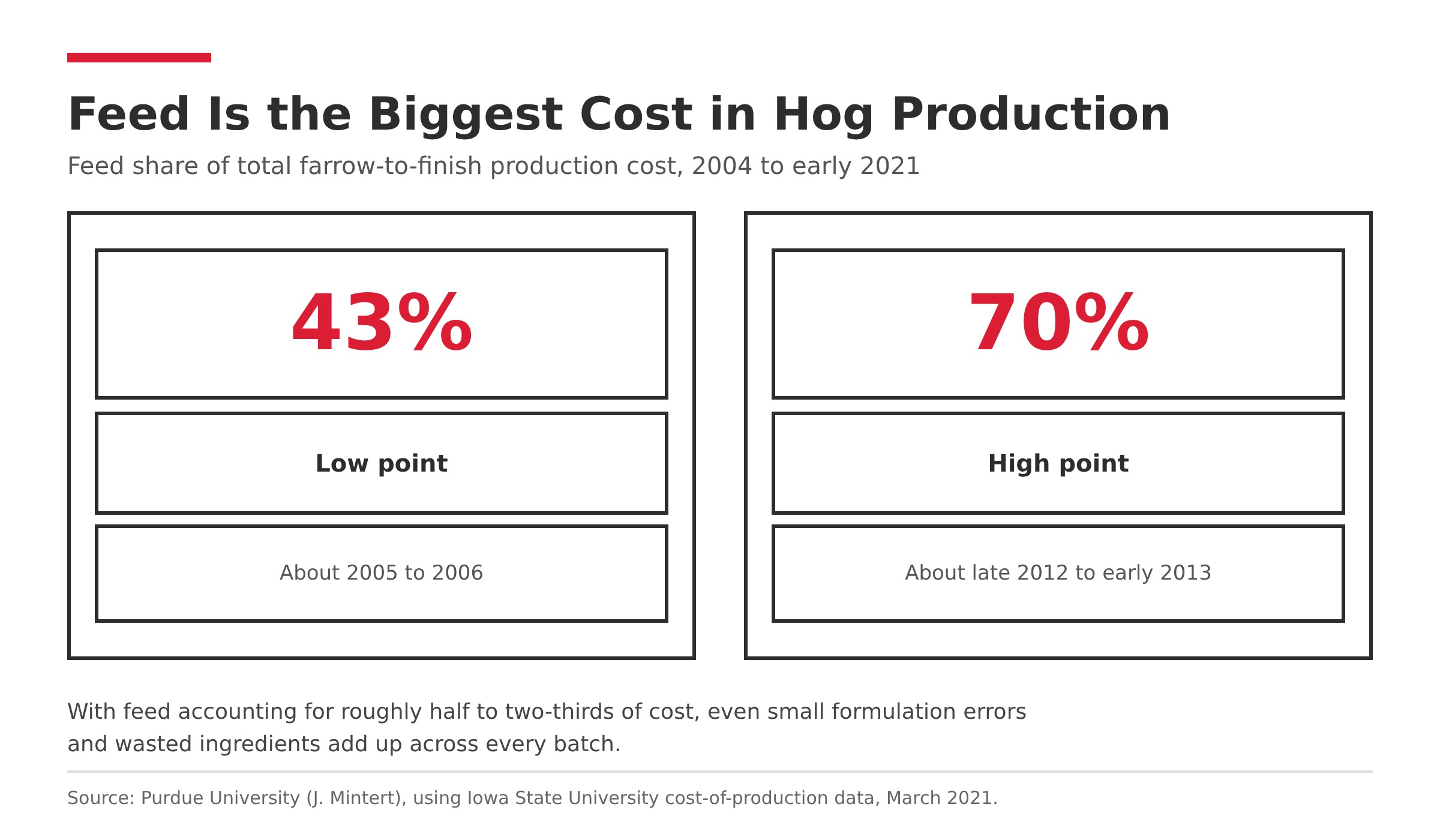
Source: Purdue University Commercial Agriculture, using Iowa State University data.
Common hidden costs of manual batching include:
- Overdosed premix and other high-value ingredients that never needed to be there
- Underdosed additions that weaken the formula
- Rework when a batch is caught out of spec
- Operator time spent scooping, weighing, and writing
- Slow, incomplete answers when an auditor asks for batch history
Why Mixer Uniformity Is the Benchmark for Batch Accuracy
Mixer uniformity measures how evenly ingredients are distributed through a batch, and the standard yardstick is the coefficient of variation (CV). CV is the standard deviation divided by the average, calculated from samples taken across the batch. A CV under 10 percent is the widely used target.
| CV result | Rating | Recommended action |
|---|---|---|
| Under 10% | Excellent | None |
| 10 to 15% | Good | Increase mixing time by 25 to 30 percent |
| 15 to 20% | Fair | Increase mixing time by 50 percent; look for worn equipment, overfilling, or ingredient sequence problems |
| Over 20% | Poor | Re-evaluate the mixing system |
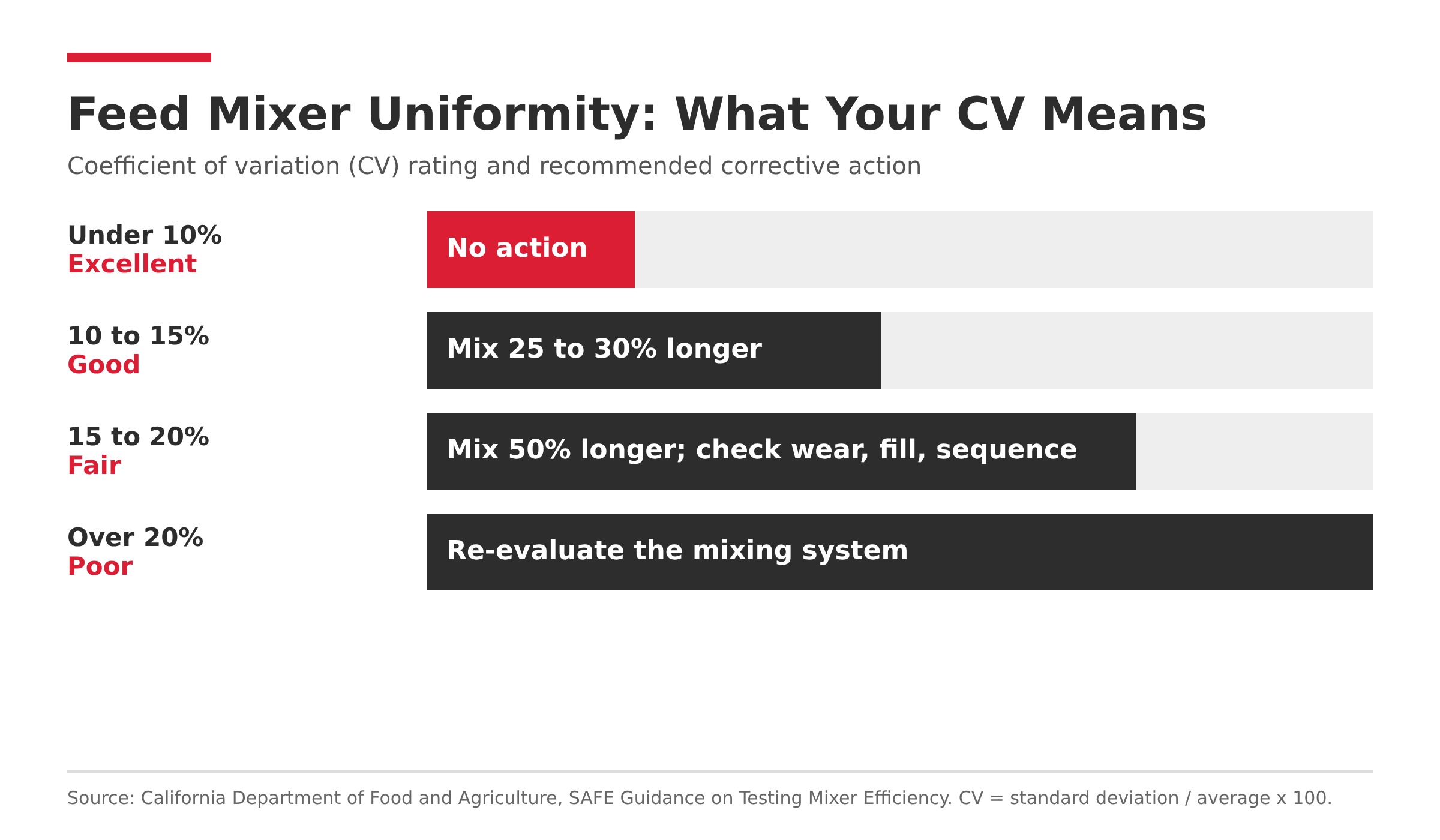
Source: California Department of Food and Agriculture, SAFE Guidance on Testing Mixer Efficiency.
Uniformity slips more often than most operators expect. A Kansas State University survey of 43 on-farm feed manufacturers found that only 42 percent had a CV under 10 percent, while 47 percent fell between 10 and 20 percent and 11 percent exceeded 20 percent. The survey dates to 1991, but it shows how often uniformity falls short without controlled processes.
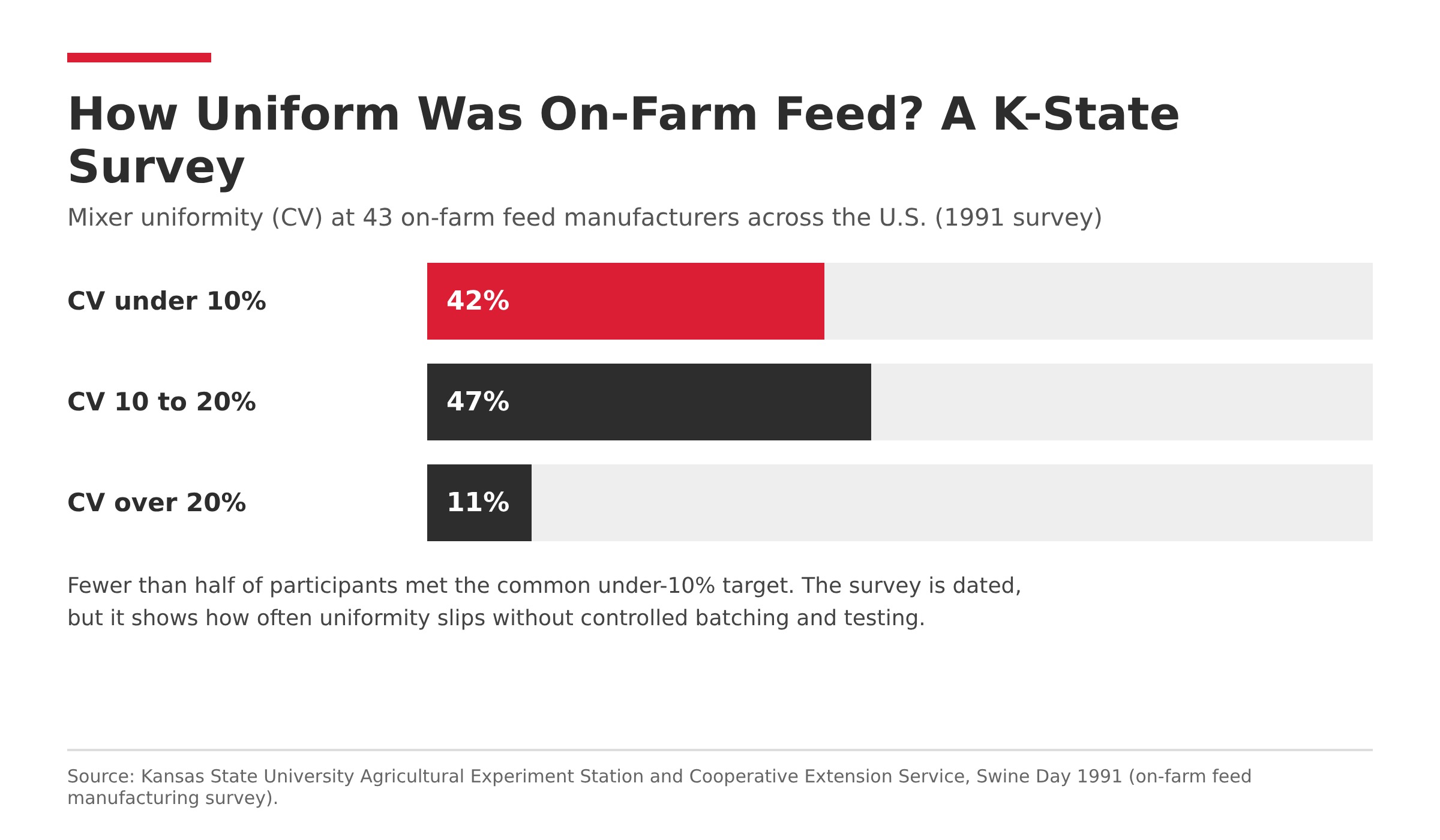
Source: Kansas State University Swine Day 1991.
What Automation Fixes and What It Does Not
Automation controls what enters the mixer, in what amount, and in what order. It does not replace mixer maintenance, correct mixing time, or uniformity testing. The California guidance lists overfilling, worn equipment, and ingredient sequence as common causes of poor CV, and automated sequencing removes one of those variables.
Core Components of an Automated Feed Mill
An automated mill is a set of components working from one recipe. Each one removes a specific source of error:
| Component | What it does | Accuracy benefit |
|---|---|---|
| Controller (PLC) | Runs gates, feeders, and mixer cycles in sequence | Removes timing errors from manual operation |
| Load cells and scales | Weigh each ingredient as it is dispensed | Replaces estimated amounts with measured weights |
| Gates and feeders | Start and stop material flow into the scale | Lets the controller land on target weight |
| Micro ingredient dosing | Dispenses vitamins, minerals, and medications | Eliminates hand-adding of small inclusions |
| Batching software | Stores recipes, inventory, and batch records | Locks the formula and logs actual weights |
| Bulk bins | Hold ingredients and feed the scale | Steady flow keeps weighing consistent |
Feed Mill Automation Software for Recipes and Records
The software layer is where recipes live and where batch records are kept. BatchNet feeding and batching software is an easily operated feeding system for livestock that supports faster batching, reporting, and inventory. Starting here gives you recipe control and a record of every batch before you touch any hardware.
Micro Ingredient Systems That Replace Hand-Adding
Small-inclusion ingredients are where manual error does the most damage, because a small mistake in weight is a large mistake in concentration. Bierman Equipment’s automated micro-ingredient dosing equipment improves accuracy in ingredient measurement and replaces pre-mixing and hand-adding methods.
How Automated Weighing Holds the Recipe
Automated weighing works as a loop: the controller opens a gate, the scale reports weight, and the controller closes the gate when the target is reached. Because the loop runs the same way every time, it holds the recipe whether the operator is new or experienced.
Ingredients do not flow alike. Corn, soybean meal, and limestone have different densities and flow behavior, and each can change with moisture and particle size. Controllers handle this with a pre-act: the weight before target at which the gate closes, so material still falling lands the batch on spec. Dense, fast-flowing ingredients need a larger pre-act than light, slow ones, and the setting can be tuned per ingredient.
| Batching step | Manual | Automated |
|---|---|---|
| Recipe entry | Read from a sheet | Loaded from stored formula |
| Bulk weighing | Operator watches the scale | Controller closes gate at target |
| Micro additions | Scooped and weighed by hand | Dosed by equipment |
| Ingredient order | Depends on the operator | Fixed sequence every batch |
| Records | Handwritten log | Electronic weights per batch |
| Consistency | Varies by shift and operator | Same steps every run |
Bulk Storage and Flow: Where Batching Accuracy Starts
Batching accuracy starts at the bin, because inconsistent flow is a source of error that software alone cannot fix. Moisture absorption in poorly sealed storage changes how material weighs and flows. Bridging and rat-holing interrupt flow mid-batch, so the scale stalls and the controller compensates.
Sealed, smooth-flowing storage gives the weighing system a predictable input. Poly storage bins for bulk ingredients suit mills that want steady flow to the scale and protection from moisture.
Traceability and Compliance Benefits of Feed Mill Automation
Automated records make compliance paperwork a by-product of production. Animal food facilities covered by the FDA rule in 21 CFR Part 507 must follow current good manufacturing practice, and many must also maintain a food safety plan with preventive controls and supporting records. Exemptions exist, so confirm which requirements apply to your facility.
Licensed medicated feed manufacturers also follow 21 CFR Part 225, which includes laboratory controls for mixing uniformity. In both cases, an electronic log of what was dispensed answers audit questions in minutes instead of a search through paper files. This is general information, not legal advice.
Where Feed Mill Automation Pays Back
Payback comes from four places, and you can measure all of them before you buy:
- Ingredient shrink: track how much premix and high-value ingredient you use against what the formula calls for
- Labor: count hours per day spent on hand-adding, weighing, and record-keeping
- Rework: count batches per month that are corrected, remixed, or discarded
- Audit time: note how long it takes to assemble batch history on request
Compare those numbers before and after installation. The higher your daily tonnage and the more hand-adding you do, the faster the comparison tends to favor automation.
How to Start With Feed Mill Automation
You do not need to rebuild the mill to begin. Start with the step that removes the most risk, then add the next one.
Modular Feed Mill Automation Upgrades
- Set a baseline: run a mixer uniformity test and weigh back a sample of micro additions to see where you stand.
- Add the software layer: recipes, inventory, and batch records come first because they need no new hardware.
- Automate micro dosing: take the highest-risk manual step out of the routine.
- Fix storage and flow: sealed bins and consistent flow protect the accuracy you just added.
Bierman Equipment tests the equipment it sells on its own farm before recommending it, and it can review your layout to find the upgrade with the fastest return. Browse our full range of equipment for feed mills and livestock operations, or talk with our equipment team about your mill.
Request a Feed Mill Consultation
Feed Mill Automation FAQs
How does feed mill automation improve traceability and compliance?
Automated systems log actual ingredient weights, lot information, and batch times electronically, so records reflect what was dispensed rather than what someone wrote down. That makes audits faster and supports the recordkeeping that FDA animal food rules require for covered facilities. Check which requirements apply to your facility.
What is a good coefficient of variation for feed mixing?
A coefficient of variation (CV) under 10 percent is widely treated as excellent mixer performance. Guidance from the California Department of Food and Agriculture rates 10 to 15 percent as good, 15 to 20 percent as fair, and over 20 percent as poor.
Does feed mill automation replace mixer uniformity testing?
No. Automation controls what goes into the mixer, how much, and in what order. Mixing time, mixer wear, and fill level still affect uniformity, so you should keep testing the mixer and retest after maintenance.
Can I automate a feed mill without replacing my existing equipment?
Often, yes. Compatibility depends on your scales, controller, gates, and mixer, so the first step is a review of your current setup. Many mills automate in stages, starting with batching software or a micro ingredient system and adding upgrades over time.
What does a micro ingredient system do?
A micro ingredient system weighs and dispenses small-inclusion ingredients such as vitamins, trace minerals, and medications automatically. It replaces pre-mixing and hand-adding, which removes the step where most small-quantity errors happen.
What is pre-act in feed batching?
Pre-act is the amount of weight before the target at which the controller closes a gate, so the material still in flight lands the batch on target. The right pre-act differs by ingredient, because dense, fast-flowing material needs a larger allowance than light, slow material.
How long does feed mill automation take to pay back?
Payback depends on your daily tonnage, current ingredient waste, labor on hand-adding and record-keeping, and rework. Measure those four numbers before you buy, then compare them after installation. Bierman Equipment can help you frame the comparison for your mill.
How does automation reduce labor and operator strain?
Automation removes hand-scooping, hand-weighing, and paper logging from the batching routine. Operators monitor the process instead of performing each step, which frees time for other work and reduces repetitive physical handling of ingredients.
Can smaller or on-farm mills use feed mill automation?
Yes. Modular systems let a smaller mill start with one upgrade, such as recipe and inventory software or automated micro dosing, without rebuilding the whole mill. Each addition builds on the last.
How much does feed mill automation cost?
Cost depends on mill size, the number of ingredients and bins, the controller and scale hardware you already have, and which components you add. Bierman Equipment quotes each project individually after reviewing your layout and goals.