


A bone crusher machine from Bierman Equipment turns small-volume rubble, brick, asphalt, and bone into reusable 1.5 to 3 inch aggregate right where you work. The Solesbee's Bone and Aggregate Crusher mounts to your excavator like a bucket, runs on the carrier's auxiliary hydraulics, and keeps crushed material on site instead of paying to haul it away.
What Is a Bone Crusher Machine Used For?
A bone crusher machine breaks hard, dense material into small, reusable pieces. The Bone and Aggregate Crusher crushes brick, light concrete block, pavers, asphalt, and bone to about 1.5 to 3 inches, so you can use the output as fill, base layer, or surfacing instead of hauling it off.
Typical jobs include:
- Turning demolished brick and block into foundation fill
- Surfacing farm tracks, lanes, and yards with crushed material
- Producing base layer below poured concrete
- Recycling old asphalt into usable aggregate
- Reducing rubble volume before it goes into a disposal skip
- Crushing small volumes of bone into aggregate-size pieces
The crusher is one of several machines Bierman Equipment carries for waste processing equipment, alongside grinders, composters, and biodigesters.
How the Bone and Aggregate Crusher Works
The crusher bolts onto your carrier like a standard bucket, and the carrier's hydraulics spin a rotating cone that crushes material against the drum wall. The process takes four steps:
- Mount: Attach it to the excavator stick with standard pins or a quick coupler, then connect it to the auxiliary hydraulic circuit.
- Scoop and sort: The bucket mouth scoops rubble and lets you sort out oversized or unwanted pieces as you load.
- Crush: A seven-sided rotating cone inside a cylindrical drum crushes the material between steel and tungsten carbide grinding faces.
- Discharge: Processed aggregate exits at the bottom, ready to compact or reuse on site.
Key Features of This Bone Crusher Machine
- Rotating cone design: a seven-sided cone inside a cylindrical drum for consistent breakdown
- Hard-wearing faces: grinding surfaces in steel and tungsten carbide
- Geared drive: built around a Series 3.5 sub gearbox
- Compact footprint: sized for small working areas and confined sites
- Multi-carrier fit: works with excavators, backhoes, skid steers, and telehandlers
- Protected hydraulics: external guards shield hydraulic components from jobsite impact
Why Crush On Site Instead of Hauling
Crushing on site removes two costs at once: hauling rubble away and buying hardcore to bring in. It also cuts truck traffic and delays on tight or remote sites, since one machine turns the debris you already have into the material you need.
Bone and Aggregate Crusher Specifications
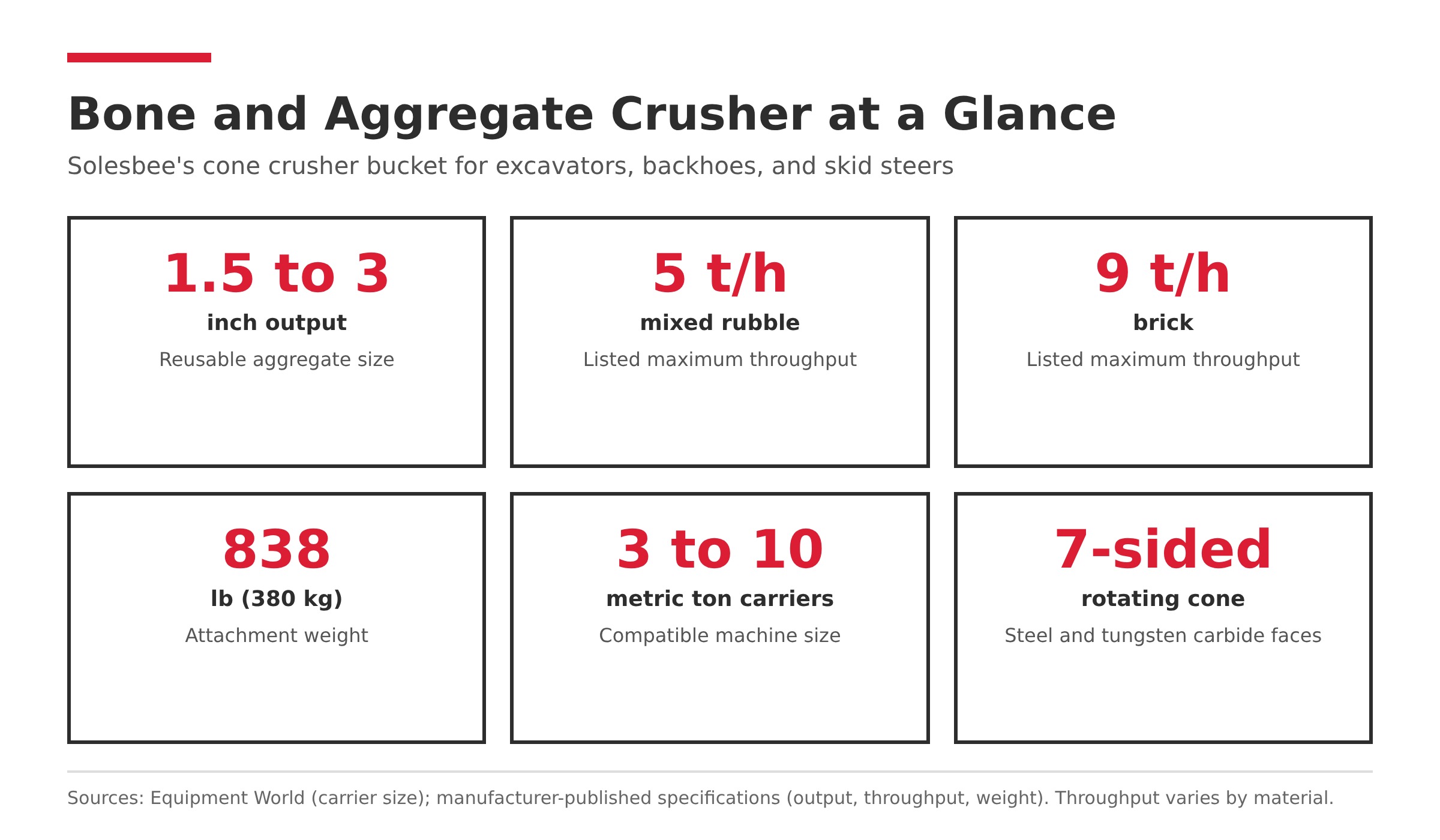
These figures come from manufacturer-published specifications for the Solesbee's crusher. Hydraulic needs vary by version, so Bierman Equipment confirms exact figures against your carrier before you order.
| Specification | Bone and Aggregate Crusher |
|---|---|
| Typical output size | About 1.5 to 3 in |
| Crusher type | Seven-sided rotating cone in a cylindrical drum |
| Grinding faces | Steel and tungsten carbide |
| Gearbox | Series 3.5 sub gearbox |
| Throughput | Up to 5 tons per hour (mixed rubble); up to 9 tons per hour (brick) |
| Attachment weight | 838 lb (380 kg) |
| Compatible carriers | Excavators, backhoes, skid steers, and telehandlers, 3 to 10 metric tons |
| Power source | Carrier's auxiliary hydraulics |
| Hydraulic requirements | Published flow ranges run from about 13 to 39 gpm, with pressure up to 3,480 psi, depending on version |
| Mounting | Standard EC or quick coupler pins on an excavator stick |
| Supplier | Bierman Equipment, a dealer for Solesbee's products |
Source: Equipment World and manufacturer-published specifications.
Download the Solesbee's Brochure
What Materials Can This Aggregate Crusher Process?
The crusher is built for small-volume brick, block, paver, asphalt, and bone waste. Use the table to see what to load and what comes out.
| Material | Suitable | Result |
|---|---|---|
| Clay construction brick | Yes | 1.5 to 3 in aggregate, fastest throughput (up to 9 tons per hour listed) |
| Light concrete walling blocks | Yes | Reusable fill and base material |
| Hollow concrete (breeze) blocks | Yes | Reusable fill and base material |
| Concrete pavers | Yes | Reusable fill and surfacing material |
| Asphalt | Yes | Reusable aggregate for tracks and yards |
| Bone | Yes, small volumes | Aggregate-size pieces; use a grinder for composting prep |
| Heavy or heavily reinforced structural concrete | Ask first | Outside the small-volume design intent |
Applications for Crushed Aggregate
The 1.5 to 3 inch output works as structural fill and surfacing, which covers most small-site jobs. Each use below keeps material on your property.
| Application | How the crushed material helps |
|---|---|
| Foundation laying | Provides compactable fill beneath footings and slabs |
| Track and yard surfacing | Gives farm lanes and work yards a firm, drainable surface |
| Landscaping | Supplies drainage stone and bedding for beds and paths |
| Roadways | Builds up base layers for access roads and driveways |
| Base layer below concrete | Creates a stable sub-base under poured concrete |
| Disposal skips | Cuts rubble volume so each skip holds more |
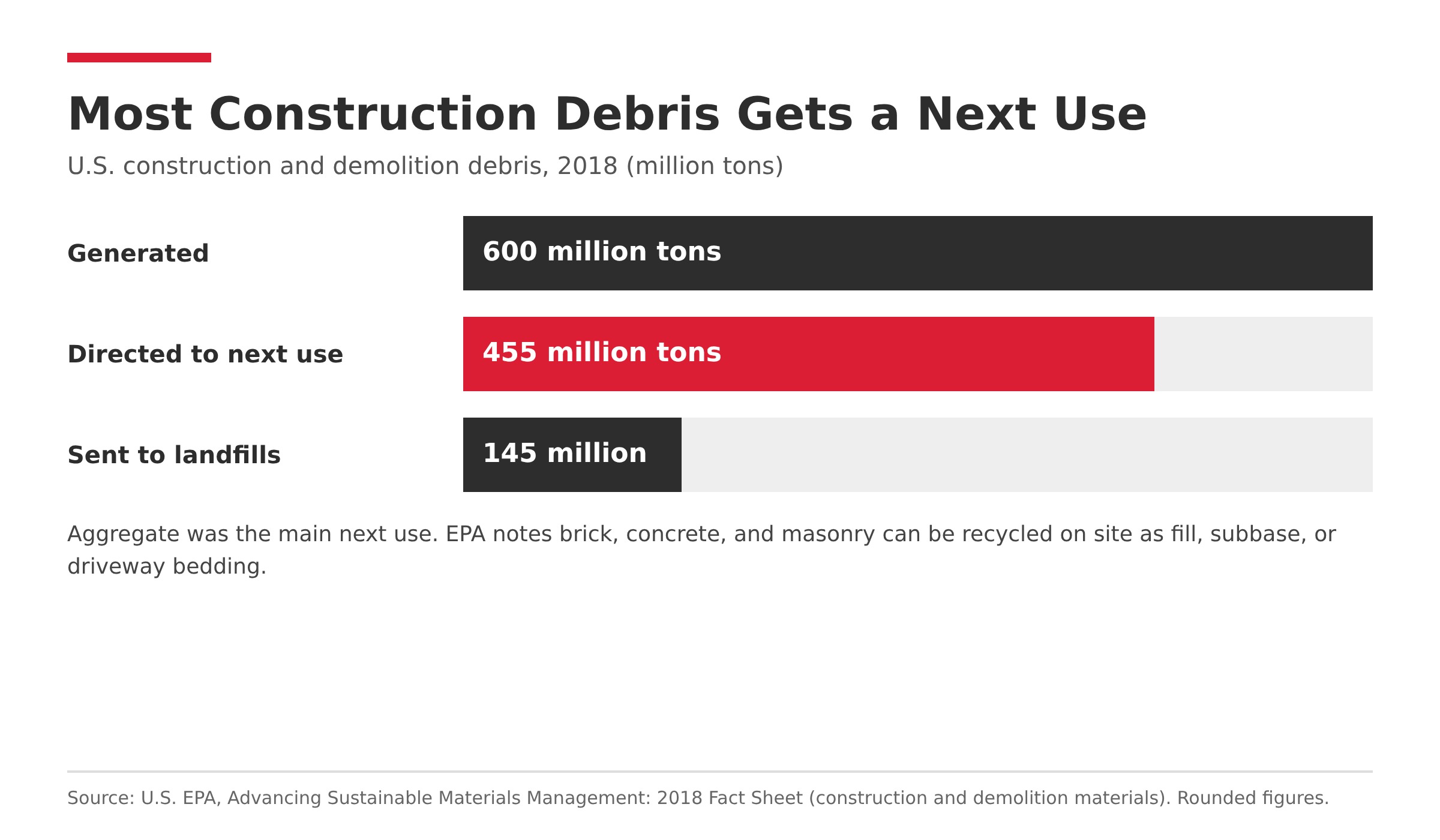
Recycling debris into aggregate is common practice nationwide. The U.S. EPA reports that 600 million tons of construction and demolition debris were generated in 2018, that just over 455 million tons went to a next use with aggregate leading, and that brick, concrete, and masonry can be recycled on site as fill, subbase, or driveway bedding.
Source: U.S. EPA, Advancing Sustainable Materials Management: 2018 Fact Sheet.
Cost Savings of Crushing Rubble On Site
On-site crushing saves money by replacing two purchases, hauling out and importing in, with one machine pass. The savings come from:
- No off-haul: debris stays on site instead of paying for trucks and disposal fees
- No imported hardcore: crushed output replaces purchased fill and base stone
- Less site traffic: fewer truck trips mean fewer delays
- No crusher rental: the attachment runs on a carrier you already own
At the listed 5 tons per hour for mixed rubble, one 8-hour day can process up to about 40 tons under ideal conditions. For brick at 9 tons per hour, that rises to roughly 72 tons. Real output depends on your material and carrier hydraulics.
Who Uses a Bone and Aggregate Crusher?
This crusher fits anyone who generates small, steady volumes of rubble and wants to reuse it. Typical users include:
- Farms and livestock operations: crushing old foundations, block walls, and brick into material for lanes, pads, and yards
- Demolition and renovation contractors: processing masonry on site instead of hauling it to a remote crusher
- Road and driveway crews: turning removed pavement into base aggregate for reuse under new surfaces
- Remote or tight sites: projects where hauling debris out and importing stone in is slow or expensive
Operating Considerations
Three habits keep the crusher productive. Feed pieces that fit the bucket mouth, sort out unwanted material as you scoop, and keep the carrier's hydraulic flow within the crusher's published range. Following the manufacturer's operating and safety instructions matters on any hydraulic attachment, and Bierman Equipment can walk you through setup when you order.
Bone Crusher Machine vs Bone Grinder: Which Do You Need?
Choose the crusher when you want aggregate. Choose a grinder when you want bone, hides, and fibrous waste reduced for composting, digestion, or rendering. They solve different problems.
| Feature | Bone and Aggregate Crusher | Power Knot BCG-315 Grinder |
|---|---|---|
| Main job | Crushes rubble, brick, asphalt, and bone into aggregate | Shreds bone, hides, fruit stones, and fibrous waste |
| Typical output | About 1.5 to 3 in | 15 to 35 mm (0.6 to 1.3 in) |
| Format | Excavator-mounted attachment | Stationary machine with hopper and bin |
| Power | Carrier's auxiliary hydraulics | 5.5 kW electric motor |
| Best end use | Fill, surfacing, roadways, base layers | Composting, biodigester feed, rendering, bone meal |
For composting or digestion prep, the Power Knot BCG-315 grinder gives a finer, more uniform output than a crusher.
Its ground output can feed LFC aerobic biodigesters, which cannot take full bones or beef hides.
How to Choose the Best Aggregate Crusher for Your Operation
Match the crusher to your carrier, hydraulics, material, and volume. Check these points before you request a quote.
| Question | What to check |
|---|---|
| What carrier will run it? | Excavator, backhoe, skid steer, or telehandler in the 3 to 10 metric ton range |
| What is the carrier's auxiliary hydraulic flow and pressure? | Compare to the crusher's published flow and pressure ranges |
| What material will you crush? | Brick, light block, pavers, asphalt, or small volumes of bone |
| How much per day? | Compare to 5 tons per hour (mixed) or 9 tons per hour (brick) |
| Where will the output go? | Fill, surfacing, roadway, or base layer on site |
Match the Carrier and Hydraulics
The crusher only performs as well as the hydraulics driving it. Share your carrier make, model, and auxiliary flow and pressure, and our equipment team will confirm the fit before you buy.
Size the Crusher to Your Volume
This is a small-volume crusher, not a quarry plant. It suits farms, contractors, and sites that generate a few tons of rubble a day, and it is not designed to replace large stationary crushing plants.
Plan the Next Step for the Output
Decide where the crushed material will go before you start, whether that is a track, a foundation, or a base layer. Operations that also need other farm tools can browse excavator and skid steer attachments that share the same carrier.
Bone Crusher Machine for Sale: Request a Quote
Bierman Equipment is a dealer for Solesbee's products, ships nationwide, and tests the equipment it sells on its own farm before recommending it. Tell us your carrier, hydraulic flow, and the material you plan to crush, and we will quote the right setup.
Bone Crusher FAQs
What is a bone crusher machine?
A bone crusher machine breaks hard, dense material into small pieces. Bierman Equipment's Bone and Aggregate Crusher is an excavator-mounted cone crusher that reduces small-volume rubble, brick, asphalt, and bone to about 1.5 to 3 inch aggregate.
What size aggregate does the crusher produce?
The crusher produces reusable aggregate of about 1.5 to 3 inches. That size suits foundation fill, yard and track surfacing, landscaping, roadways, and a base layer below poured concrete.
What kind of machine do I need to run it?
The crusher is designed for 3 to 10 metric ton carriers, including excavators, backhoes, skid steers, and telehandlers. It runs off the carrier's auxiliary hydraulics and mounts with standard pins or a quick coupler. Confirm hydraulic flow and pressure with Bierman Equipment before ordering.
How much material can it crush per hour?
Published specifications list up to 5 tons per hour for mixed rubble and up to 9 tons per hour for brick. Actual throughput depends on material hardness, feed rate, and the carrier's hydraulic output.
Can this machine crush concrete?
It handles light concrete walling blocks, hollow concrete blocks, and concrete pavers, along with clay brick and asphalt. It is sized for small-volume rubble, so ask Bierman Equipment before planning on heavy or heavily reinforced structural concrete.
Can it crush bones for composting or a biodigester?
It can crush bone to about 1.5 to 3 inch pieces, but composting and biodigester feed usually need finer material. A dedicated grinder such as the Power Knot BCG-315 reduces bone and hide to 15 to 35 mm (0.6 to 1.3 in) and is the better fit for that job.
Can I mount the crusher on a skid steer or backhoe?
Yes. The manufacturer lists compatibility with excavators, backhoes, and skid steers within the 3 to 10 metric ton carrier range. Match your carrier's auxiliary hydraulic flow and pressure to the crusher's requirements.
How much does a bone and aggregate crusher cost?
Pricing depends on the model version, shipping destination, and any options. Bierman Equipment is a dealer for Solesbee's products and quotes each order individually. Send your carrier make and model, auxiliary hydraulic flow, and the material you plan to crush.
What warranty does the crusher carry?
The crusher is built by Auger Torque and sold in the U.S. through Solesbee's, and it carries the manufacturer's warranty. Terms can vary by component and region, so confirm current warranty details when you request a quote.
