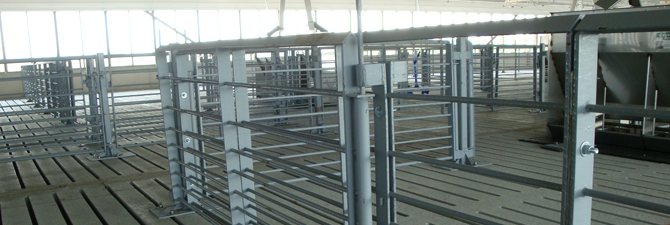


Animals find weakness fast. A gate that gives even slightly under snout pressure becomes a target, and a 300-pound finisher using its nose as a lever against a marginal weld is a problem that compounds quickly. Hog fencing and gating that hold up under that kind of daily pressure, not equipment that looks fine on a spec sheet and fails at the hinge six months in, is what Bierman Equipment builds through Schick Enterprises and tests on working farm operations before it ever reaches a customer's barn.
Swine Gating and Hog Fencing Systems Built for Real Barn Conditions
From finishing pen panels to custom breeding configurations, these are pig-tight systems designed for hog farmers, facility managers, and agricultural builders who need containment that holds under real daily pressure. The goal of a well-designed gating system is to make pigs do most of the work. When alleys channel toward open space and gates swing cleanly without hesitation, animals move forward on their own. That is the mechanical outcome of the right geometry, the right swing weight, and latches that do not require two hands to operate.
These gates are engineered to absorb what a heavy finishing hog throws at them, year after year, without the weld failures and hinge sag that plague lighter-gauge alternatives. Whether you are outfitting a new build or retrofitting an existing barn, the system is designed to fit slatted floors and wall brackets without on-site guesswork.
How Pig Gates Improve Workflow and Containment
A gating system that requires two people to operate safely is not really a system. Well-balanced hinges and one-handed latch mechanisms let a single operator keep a sorting board in one hand and control the gate with the other, which is the practical standard these gates are built to meet.
Solid containment also prevents the downstream headache of accidental pen mixing. When a gate fails mid-sort and animals from two weight groups intermingle, that is not a quick fix. It means managing stress responses, potential injury, and disrupted feed schedules. Gates that hold their position and latch cleanly on the first try eliminate that scenario before it starts.
Gating for Breeding and Gestation Configurations
For breeding and gestation setups, the gating requirements shift considerably. Evolving state-level welfare regulations have accelerated the move toward group pen layouts. As of 2022, gestation crate bans or space requirements allowing sows to stand and turn around freely covered 9 states and roughly 3 percent of the national herd, according to USDA's Economic Research Service, with Ohio, a major production state, set to implement its own ban in 2026. Managing social aggression and feeding competition within group pens requires gating that integrates with the broader housing setup, and these systems are designed to work alongside specialized sow housing equipment to give producers layout flexibility that protects subordinate animals during feeding without rebuilding an entire barn around a single configuration.
Breeding pen layouts are also shaped by how sows are bred. Sows and gilts in the U.S. are serviced almost exclusively through artificial insemination, with less than 3 percent bred via traditional pen mating according to USDA APHIS's National Animal Health Monitoring System. That makes AI-compatible stall access the practical standard rather than the exception, so gating needs to allow safe, unobstructed technician access and secure individual sow positioning during insemination.
- Group housing integration: Pen gating designed for the turn-around space requirements of current and emerging state-level welfare standards
- Breeding pen layouts: Configured for unobstructed technician access, since AI-compatible stall access is the practical standard
- Sow housing compatibility: Gate systems that integrate with sow housing equipment to manage feeding competition and social hierarchy in group pens
Choosing Hog Fencing Gate Sizes, Latches, and Panel Materials
No two barns carry the same specifications, and the right gate for a nursery pen is a different piece of equipment than what belongs on a gestation alley. Panel height, rod diameter, material finish, and latch type all shift across production phases, and getting those specs wrong at the buying stage means field modifications that weaken the structural integrity of the installation.
| Production Phase | Recommended Material Finish | Latch Type |
|---|---|---|
| Nursery | Hot-Dipped Galvanized Steel | Heavy-Duty Flipper |
| Wean-to-Finish | Hot-Dipped Galvanized Steel | Heavy-Duty Flipper |
| Gestation / Breeding | Solid Steel / Hot-Dipped | Double-Drop Pin |
Panel heights and exact steel gauges for each phase should be confirmed directly with your Bierman representative, since barn-specific variables such as slatted floor configuration and existing wall bracket placement affect the final engineering specs. Bierman Equipment provides CAD layouts for every order, so the engineering is worked out before anything ships.
Planning Pen Layouts and Access Points
Pen layout is where most of the operational friction in a swine facility either gets solved or baked in permanently. Stocking density sets the baseline constraint. Recent industry survey data puts the average finishing facility in the U.S. at roughly 7.2 square feet per pig, with a typical working range of 6.8 to 8.0 square feet per pig. At that density, the placement of every access point, corner gate, and alley entry directly affects how cleanly animals move and how much crowding stress accumulates during sorting and cleanout.
Access points need to be wide enough for cleanout machinery and positioned so animals do not have to double back against the flow of the herd. Corner gates placed at the right angles let a single operator direct movement without chasing. Getting this right on paper before concrete is poured or posts are set is much cheaper than retrofitting a layout that fights you every morning.
Paneltim plastic panels offer a practical option for custom pen dividers and walls where hygiene and wash-down speed matter. The panels are lightweight, non-porous, and structurally sound, so they do not harbor bacteria the way painted steel can once surface corrosion begins, and they clean down fast. For facilities running tight turnaround schedules between groups, that difference in wash-down time adds up across a production year.
Reducing Labor and Stress During Animal Handling
High-stress handling injures pigs and people. Bruising, downed animals, and handler fatigue are all downstream results of gates that do not swing cleanly, latches that require two hands and a shoulder, or alleys that funnel animals into dead ends. The equipment itself is part of the handling protocol.
Quick-latch mechanisms let operators secure a pen instantly, with no fumbling over a chain wrap or a rust-seized pin while a 250-pound hog tests the gap. Smooth-swinging gates, properly balanced on their hinges, prevent animals from getting pinched or bruised during the transition between pens. These are not extras reserved for large operations with dedicated handling staff. They matter just as much on a two-person operation where every sort day is already a full day.
Durable Hog Fencing Options for Swine Facilities
Selecting the right barrier for each production phase comes down to the specific mechanical and hygiene demands of that environment. A nursery pen and a finishing alley are not the same problem, and treating them as the same is how facilities end up with fencing that either over-engineers a low-pressure zone or fails too soon where it matters most. Bierman Equipment's lineup covers the primary production environments:
- Heavy-duty steel penning: Solid steel rod construction built to resist sustained lateral pressure and rooting behavior from heavy sows and finishing hogs, eliminating the flex and weld fatigue that let animals identify and exploit weak points.
- Hygienic plastic dividers: Lightweight, non-porous panels that remove bacteria harbor points and cut wash-down time between groups, particularly effective in nursery and wean-to-finish environments where pathogen management between turns is a priority.
- Sorting alley gates: Specialty swing gates engineered to integrate with an automated hog sorting system like the SortAll Revolution 2, streamlining weight-based sorting and market prep without manually re-drafting every animal.
Why Material Finish Determines Long-Term Cost
Confinement buildings are harsh environments. Slatted floors drain waste directly into below-floor concrete manure storage pits, and the resulting ammonia-laden atmosphere, combined with caustic cleaning chemicals used between groups, degrades standard painted steel faster than most operators anticipate. Rust typically starts at weld points first, which also happen to be the highest-stress locations on a gate. Once a weld corrodes through, the gate does not just look bad. It develops a structural gap that a rooting sow will find and exploit.
Hot-dipped galvanized steel addresses this by providing complete zinc coverage inside and out, including at the welds. The galvanizing process coats the full gate geometry rather than painting over the surface, so there is no paint layer to chip or peel away from a weld seam. For facilities running aggressive wash-down schedules with high-pH cleaners, the difference in service life between painted and hot-dipped gates is not marginal.
Custom Configurations for Complex Barn Designs
No two barns are laid out the same way. Whether a facility runs a simple finishing pen setup or a multi-phase operation with separate nursery, wean-to-finish, and gestation wings, Bierman Equipment can supply custom-sized gates built to fit slatted floor spans and wall bracket positions. Custom lengths eliminate the field modifications, angle grinders, bolt-on extensions, and improvised spacers that introduce new weak points into an otherwise sound installation. CAD layouts are provided for every order, so each gate arrives sized for the actual barn rather than a close approximation of it.
It is also worth confirming your state and local siting requirements for swine confinement structures before finalizing a layout. Separation distance and permitting rules vary by state and by animal unit capacity, and getting the layout right before construction starts is substantially less expensive than correcting it after the concrete is poured.
Why Buy Your Hog Fencing and Gating Through Bierman Equipment
Bierman Equipment runs this equipment on our own operation before offering it to customers, and Tim Bierman brings hands-on farming experience to every layout consultation. That background means less catalog review and more working through the specific limits of your barn, your herd size, and your handling workflow. We are also planning to add stainless steel gating to the lineup, so if that finish is a fit for your facility, it is worth getting on the list early since production capacity will be limited at launch.
As part of Bierman's feed mill and livestock equipment lineup, hog fencing and gating is often specced alongside sow housing, sorting, and feed handling equipment rather than purchased in isolation, and you can see the rest of what we carry across Bierman Equipment's complete equipment lineup.
Ready to work through your barn layout? Get in touch with our team for a custom quote built around your actual pen configuration, not a generic catalog spec.
Hog Fencing and Gating Frequently Asked Questions
How does the regulatory shift away from gestation crates affect breeding pen gating layouts?
Evolving state-level welfare regulations are changing gating layouts at a pace that is forcing producers to make capital decisions sooner than many expected. As of 2022, gestation crate bans or space requirements allowing sows to stand and turn around covered 9 states and roughly 3 percent of the national herd, with Ohio set to implement a ban in 2026. Transitioning to group pen gating introduces new layout challenges around social aggression and feeding competition that individual crate systems did not require producers to solve.
Why is artificial insemination the primary driver for modern breeding pen gating designs?
Breeding pen layouts in U.S. swine facilities are shaped almost entirely by the widespread use of AI, since less than 3 percent of sows and gilts are serviced via traditional pen mating. Gating must be configured to allow safe, unobstructed technician access and secure individual sow positioning during insemination, meaning stall geometry and access-point placement are driven by technician workflow rather than boar movement.
How do slatted concrete floors affect gating post installation?
Confinement buildings use slatted concrete floors to drain waste directly into below-floor manure storage pits. Gating posts must be anchored to those slats using heavy-duty T-bolts or bolt-on bracket systems that do not compromise the structural integrity or liquid-tightness of the under-barn storage walls. Post placement needs to account for slat joint locations to avoid cracking the concrete at the anchor point.
How do group housing systems manage social aggression and feeding competition through gating?
Group housing layouts address the aggression problem through gating configurations that give subordinate sows protected retreat space: electronic feeding stations, free-access stalls with individual entry gates, or partial-barrier designs that break sightlines between dominant and subordinate animals. The gating geometry in these systems does real behavioral work. It is not just containment.
What is the difference between painted steel and hot-dipped galvanized gating?
Painted steel relies on a surface coating that can chip or peel, especially at weld points, which are also the highest-stress locations on a gate. Hot-dipped galvanized steel is coated with zinc inside and out, including at the welds, so there is no paint layer to fail. In confinement buildings running aggressive wash-down schedules with high-pH cleaners, hot-dipped construction typically lasts significantly longer.
Do I need to worry about siting and separation distance requirements before adding new gating?
In most cases, gating and pen configuration upgrades inside an existing barn do not trigger new siting reviews, but expansions that increase animal unit capacity or add new structures often do. Requirements vary by state and by operation type, so it is worth confirming your specific siting and permitting rules before finalizing a layout, especially if the project involves new construction rather than an interior retrofit.