


|
When daily washdowns, constant moisture, and ammonia work against your barn walls, the wall surface decides how much time you spend on cleanup and repairs. Polypropylene wall panels give swine barns, dairy parlors, meat processing rooms, and food facilities a rigid, lightweight, washable surface that does not rot, rust, or soak up moisture. Paneltim panels are twin-wall polypropylene copolymer sheets with a sealed internal cell structure, built to handle hose-downs, animal contact, and humid conditions year after year. If you are tired of scrubbing stained plywood, patching rusted metal, or replacing rotted boards, a plastic wall system built for livestock buildings removes those repeat jobs from your calendar. |

|
Why Plywood, Metal, and Raw Concrete Wear Out in Livestock Buildings
Animal housing is one of the hardest environments for any wall material. Wash water, manure, humidity, and ammonia reach the same surfaces every day, and animals lean on, push against, and bump into those walls constantly. Traditional materials each fail in their own way.
| Wall Material | Common Problem in Animal Housing | Effect at Cleanup |
|---|---|---|
| Plywood and lumber | Absorbs moisture, swells, and eventually rots | Porous surface that holds organic debris |
| Painted or galvanized steel | Rusts where coatings wear, chip, or scratch | Corrosion needs repair, and some disinfectants attack metal |
| Raw concrete | Porous unless it is sealed or coated | Rough surface takes longer to clean thoroughly |
| Polypropylene panels | No wood to rot and no steel to rust | Smooth, non-porous face that rinses clean |
Surface porosity matters for more than appearance. A peer-reviewed review of virus persistence on porous materials found that porcine epidemic diarrhea virus and influenza A virus stayed viable longer on wood than on stainless steel. Animal health guidance from the Center for Food Security and Public Health, built on USDA APHIS preparedness planning, describes wood as extremely porous and difficult to disinfect, and advises removing decaying wood altogether.
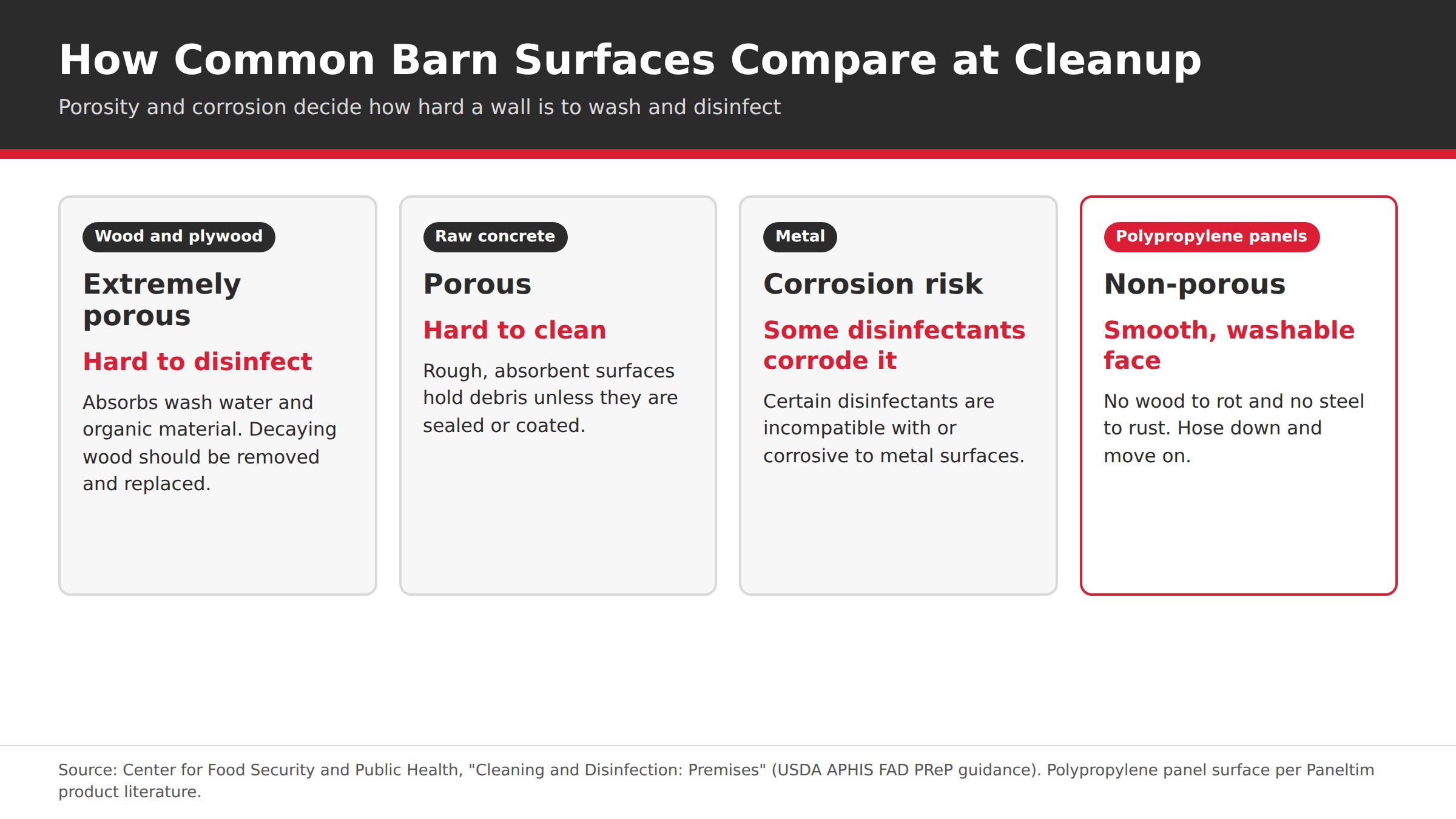
Swapping a porous or corroding wall surface for a smooth plastic one attacks the problem at its source. There is nothing for moisture to soak into and nothing for rust to eat through.
Polypropylene Wall Panels Engineered for Daily Washdowns
Paneltim panels are made from polypropylene copolymer and built as a twin-wall sandwich, with two smooth outer skins joined by an internal cross-rib cell structure. The result is a sheet that is light enough to carry and install, yet rigid enough to stay flat on a wall or ceiling under real barn conditions.
Polypropylene Wall Panels That Do Not Rot or Rust
Polypropylene is a plastic, so there is no organic material to decay and no metal to corrode. Standing water, high humidity, and repeated washing do not swell the panels or break them down the way they break down plywood. The panels keep their shape and appearance season after season.
- Built for daily washdowns: the smooth outer skin rinses clean without a coating that can wear off.
- No rot, no rust: moisture has nothing to attack, so there are no soft spots, stains, or flaking paint to maintain.
- Lower cleaning effort: the non-porous face keeps organic buildup on the surface, where a hose can reach it.
- Fully recyclable: the manufacturer lists the panels as 100 percent recyclable at the end of their service life.
Moisture and Ammonia Resistance
Livestock buildings combine wet surfaces with ammonia from animal waste, a pairing that speeds up damage to many conventional materials. The polypropylene copolymer used in Paneltim panels is a stable, corrosion-resistant plastic, and the cell structure stays closed on all sides. Even when a sheet is cut to size, the internal cells remain closed, which helps keep dirt and moisture from working their way into the panel.
Rigid Twin-Wall Construction for Animal Contact
Pigs lean, calves push, and equipment bumps walls during feeding and cleaning. The internal rib structure spreads those loads across the panel, giving the wall high bending resistance so it stays straight and true. The Multipower style uses a square 50 mm cell grid that makes the panel equally strong in length and width, while the Lightweight style trades some mass for easier handling on large wall and ceiling runs.
Ready to price out a refit? Our team can build a material estimate and layout plan around your building dimensions.
Cleaning and Biosecurity Benefits for Barns and Food Facilities
Cleaning comes before disinfection in any sound biosecurity routine, and the wall surface has a direct effect on how well cleaning goes. A surface that traps residue makes every washdown slower and less certain. A smooth, sealed surface does the opposite.
Smooth Surfaces Shorten Washdown Time
The non-porous skin on a polypropylene panel lets water and detergent sheet off instead of soaking in. Crews spend less time scrubbing stained corners and more time on the rest of the turnover checklist between groups of animals. For operations that wash every day, even a modest time savings per room adds up quickly over a year.
Closed Cells Keep Moisture and Debris Out
Because the internal cells are closed all around, moisture and dirt do not collect inside the panel body. That matters in food-handling and processing rooms where hygiene rules leave no room for hidden damp spots. A wall that stays dry on the inside is also less likely to develop the swelling and delamination that shorten the life of board products.
Fewer Seams Where Buildup Can Settle
Paneltim sheets can be welded into larger sizes and custom shapes with standard plastic welding methods. Welded joints take the place of sealant-dependent joints, which means fewer lines of caulk where mold and residue can establish over time. Specialized plastic profiles handle corners, edges, and transitions so the finished wall reads as one continuous surface.
Where to Use Paneltim Panels in Agricultural and Food Buildings
The same sheet that lines a farrowing room also works as a ceiling in a processing room or as the body of a storage tank. The most common uses fall into a few groups.
Interior Walls, Ceilings, and Equipment Enclosures
|
Panels work for interior partitioning, full wall cladding, ceiling cladding, and custom enclosures around equipment. Their low weight means overhead installation does not add significant structural load, and the finished envelope stays washable from floor to ceiling. They pair well with the rest of a modern livestock housing and feed equipment lineup when you are outfitting a barn from the ground up.
|

|
Livestock Housing, Pens, and Partitions
Paneltim panels suit modern barns, group housing, penning, and partitioning that must meet strict hygiene expectations. They are well suited to housing calves, pigs, sheep, goats, chickens, dogs, cats, rabbits, and more. In a swine building, panels can line the walls of gestation and farrowing rooms, and they fit naturally alongside equipment for sow barns.
Panels also make durable pen dividers. A solid, washable partition keeps animals separated without the bent rails and rust streaks that develop on older materials, and it can be combined with pig pen gates and fencing where you need working access points.
Meat Processing Rooms and Food Facilities
Processing rooms, dairy parlors, and other food-handling areas demand surfaces that can be washed hard and often. A smooth plastic wall and ceiling system gives these rooms a clean, bright finish without the upkeep of painted board or coated block. Paneltim also publishes a flyer on plastic panels in the food industry, available in the product literature.
Applications Beyond the Barn Wall
The same sandwich panel serves many other jobs, which gives farms and processors a single material to stock and fabricate.
Infrastructure
Flooring, walling, doors, staircases, cabins, trailers, mobile sanitary units, technical rooms, and sports boarding.
Air Handling
Air ducts, air scrubbers, heat recovery units, air filters, and nitrogen installations.
Solids
Plant boxes, furniture, packaging applications, sedimentation tanks, and mining uses.
Liquids
Liquid storage tanks, fish tanks, water reservoirs, swimming pools, fish ponds, grease traps, and similar builds. If you would rather start with a finished vessel, look at poly feed storage bins and tanks before fabricating your own.
Panel Specifications and Sizing
|
Paneltim builds its panels in two main styles for agricultural and industrial use. Lightweight panels use a larger cell and the lowest weight per square foot. Multipower panels use a tighter square cell for equal strength in both directions. Both are made from polypropylene copolymer and both have a smooth, non-porous surface.
|

|
| Specification | Paneltim Lightweight | Paneltim Multipower |
|---|---|---|
| Material | Polypropylene copolymer | Polypropylene copolymer |
| Thickness | 20 mm (0.8 in) or 50 mm (2 in) | 50 mm (2 in) |
| Internal cell size | 100 x 50 mm (about 4 x 2 in) | 50 x 50 mm (about 2 x 2 in) |
| Approximate weight | 8 to 10 kg/m² (1.6 to 2.0 lb/ft²) | 12 to 13 kg/m² (2.5 to 2.7 lb/ft²) |
| Wall thickness | 3.5 mm (0.14 in) | 3.5 to 4.5 mm (0.14 to 0.18 in) |
| Sheet sizes | 1,200 x 1,000 mm (about 47 x 39 in); 50 mm also in 2,600 x 1,000 mm (about 102 x 39 in) | 1,200 x 1,000 mm and 2,600 x 1,000 mm |
| Surface finish | Smooth, non-porous | Smooth, non-porous |
| Fire rating, chemical resistance, thermal conductivity | Available on request | Available on request |
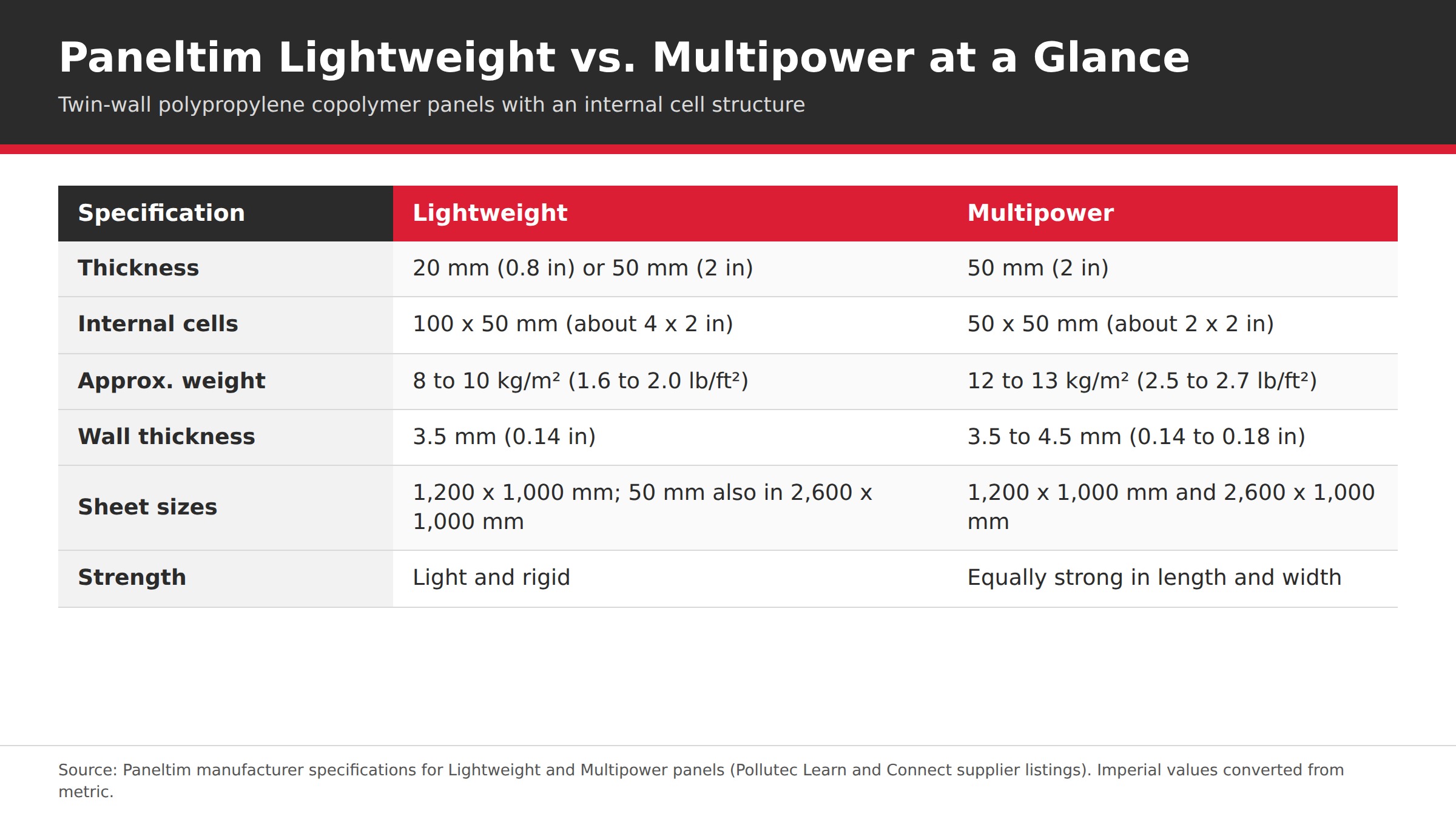
Available thicknesses and sheet sizes can vary by order, so confirm current options against your wall and ceiling dimensions before you finalize a layout.
Paneltim Panels at Hilltop Swine
Installation, Insulation, and Long-Term Maintenance
Installing the Panels
Installation uses standard tools together with plastic profiles designed to accommodate thermal expansion, so joint gaps are set by the system and not by guesswork. Panels can be cut, drilled, and routed on site, which lets crews run utility lines or fit around equipment without specialty fabrication gear. The light weight keeps handling easy, including overhead ceiling work where a heavier board would need a second set of hands.
Insulation Value of the Internal Cells
The air held inside the cells gives the panel some insulating value, which helps moderate surface temperatures and reduce condensation on interior walls through seasonal swings. Because insulation needs differ from building to building, ask for the thermal conductivity data when you plan an enclosed or climate-controlled room. To request a material estimate and layout, send your wall and ceiling dimensions along with the type of animals or processes the room will serve.
Everyday Maintenance
Maintenance is simple. Remove loose debris, wash with water and your normal detergent, rinse, and let the room dry. There is no repainting cycle and no board replacement schedule to track. Follow the manufacturer's guidance on cleaning chemicals and water temperature for your specific panel style.
Planning a Panel Retrofit or New Build
A short checklist keeps a panel project on schedule and on budget.
- Measure every wall and ceiling run. Include door openings, windows, and equipment cutouts.
- Choose the panel style and thickness. Match cell size and weight to the load, the span, and the animals in the room.
- Plan profiles and seams. Decide where welded joints, corners, and edge profiles will go before ordering.
- Confirm utilities. Mark lighting, ventilation, water lines, and electrical runs that must pass through the panels.
- Review the estimate. Compare panel quantities against sheet sizes to limit cutting waste.
Bierman Equipment evaluates equipment on its own farm before recommending it, and serves operations nationwide, so you get practical guidance on what holds up in working barns.
Request a Paneltim Panel Estimate
Get a Material Estimate and Layout PlanShare your wall and ceiling dimensions, the type of building, and your timeline, and our team will follow up with pricing and a layout built around your project.
|
Paneltim Downloads and Product Literature
Manufacturer flyers cover detailed layouts, profile options, and application examples.
- Industry plastic panels flyer
- Anti-slip plastic panels flyer
- Polypropylene profiles flyer
- Constructions made with plastic panels
- Plastic panels in the food industry
Frequently Asked Questions About Polypropylene Wall Panels
What are polypropylene wall panels?
Polypropylene wall panels are lightweight plastic sheets with two smooth outer skins and an internal cell structure. Paneltim panels use polypropylene copolymer and are used to line walls and ceilings in livestock barns, meat processing rooms, and food facilities where surfaces are washed often.
Can the panels handle daily washdowns?
Yes. The smooth, non-porous face is designed for frequent washing and does not depend on paint or a coating that can wear away. Follow the manufacturer's guidance on cleaning chemicals and water temperature for your panel style.
Do the panels rot, rust, or absorb moisture?
No. Polypropylene is a plastic with no wood to decay and no metal to corrode. The internal cells stay closed on all sides, even when a sheet is cut to size, which helps keep moisture and dirt out of the panel body.
How thick are Paneltim panels, and what sizes are available?
Paneltim Lightweight panels come in 20 mm (0.8 in) and 50 mm (2 in) thicknesses, and Multipower panels come in 50 mm (2 in). Standard sheets measure 1,200 x 1,000 mm, and 50 mm panels are also available in 2,600 x 1,000 mm. Confirm current options for your project with our team.
Can the panels be cut and customized on site?
Yes. Panels can be cut, drilled, and routed with standard tools, and they can be welded into larger sizes and custom shapes. Plastic profiles handle corners, edges, and thermal expansion so joints stay clean.
Why choose polypropylene panels over plywood or metal?
Plywood absorbs moisture and rots, and metal rusts where coatings wear. Polypropylene panels do neither, and their smooth surface is quicker to clean. They are also lightweight, which makes handling and installation easier.
Are the panels recyclable?
Yes. The manufacturer lists Paneltim panels as 100 percent recyclable.